
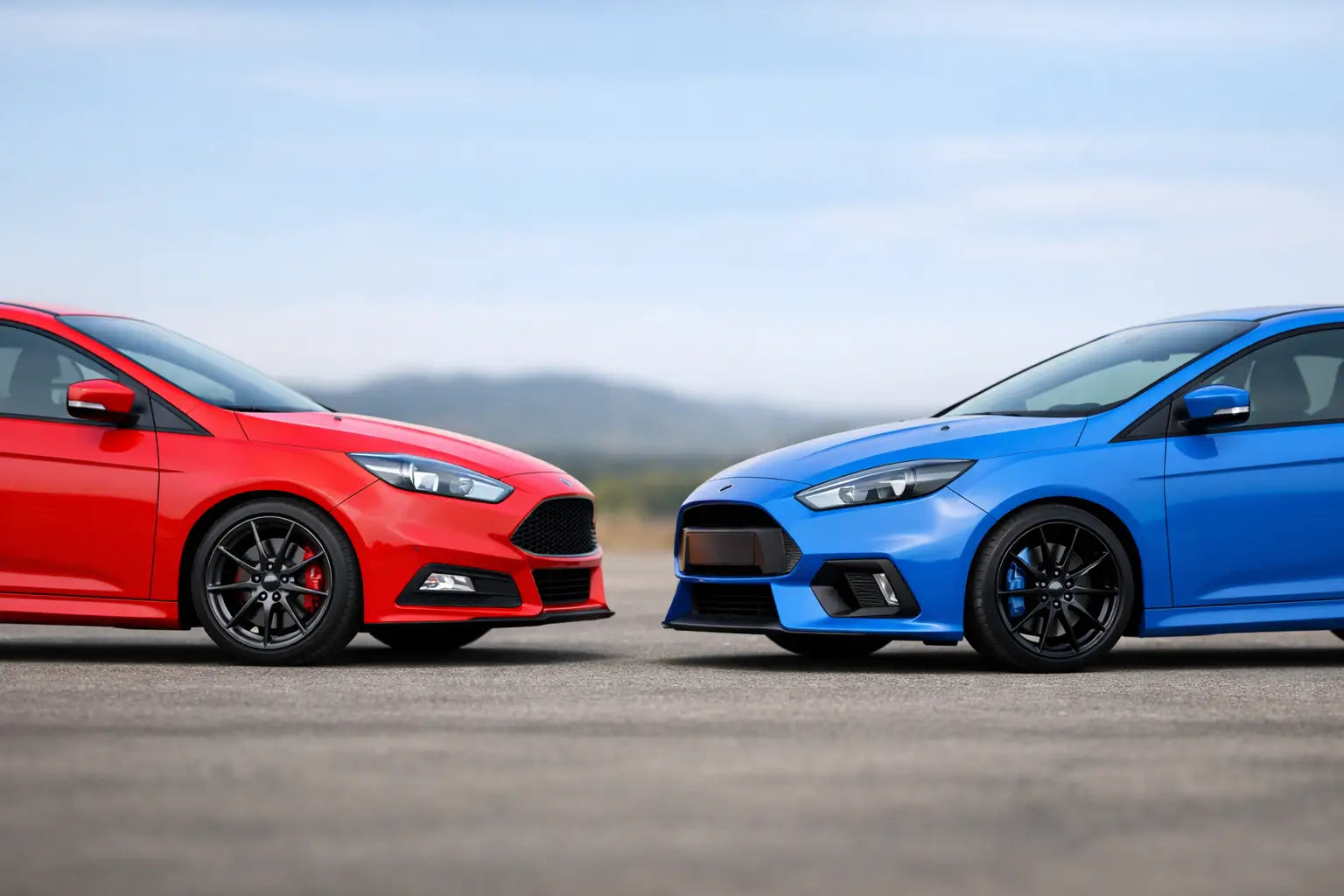
You feel the difference between these two before you even get properly into the throttle. The Focus ST wants to be driven hard every day. The RS feels like it arrived from the factory with a chip on its shoulder. If you are weighing up Focus ST vs Focus RS, you are not choosing between good and bad - you are choosing between two very different versions of Ford performance.
That matters, because the wrong car for your use case can get expensive fast. One is easier to live with, easier to buy, and easier to build into a sharp fast-road package. The other brings serious factory hardware, more grip, more attitude, and a much higher ceiling when the road opens up or the circuit starts calling.
Focus ST vs Focus RS at a glance
The Focus ST has always sat in the sweet spot for enthusiasts who want proper pace without giving up daily usability. It is the car you can commute in, load up at the weekend, then take out for a B-road blast and still come back grinning. Front-wheel drive keeps the formula simple, weight stays more manageable, and ownership tends to be less punishing.
The Focus RS goes harder from the outset. More power, a more aggressive chassis, four-wheel drive traction, and a factory setup that leans much closer to track-ready than warm hatch. It is the more serious machine, but it also asks more from your budget and, in some cases, your patience.
If you are deciding with your head, the ST often makes the strongest argument. If you are deciding with your right foot, the RS has a habit of ending the conversation.
Performance and drivetrain differences
This is where the gap becomes obvious. The modern Focus ST delivers strong turbocharged shove and enough pace to feel properly quick on UK roads. It is fast in the way a good hot hatch should be - eager, usable, and entertaining without constantly feeling like you need race fuel and clear tarmac to enjoy it.
The Focus RS turns that up several clicks. With its four-wheel drive system, harder-edged setup and stronger power output, it launches harder, exits tighter, and finds grip where the ST starts asking more from the front axle. In poor weather or on broken surfaces, that traction advantage is not just a spec sheet win. It changes how confidently you can deploy the car.
That does not automatically make the RS more fun for everyone. A front-wheel-drive ST can feel more adjustable at sane road speeds, and many drivers enjoy working with the chassis rather than relying on drivetrain grip to fire them out of a bend. The ST can feel lighter on its feet and less intense when you are not driving flat out.
How they feel on the road
The ST is the better all-round road car for most owners. It has enough power to stay exciting, enough compliance to cope with daily use, and fewer moments where it feels like overkill. You can exploit more of it more often, and that matters on crowded roads where outright performance is not always usable.
The RS feels more special, more urgent, and more mechanical in its intent. It has the sort of character that makes a short drive feel like an event. But that edge can become tiring if your reality is motorway miles, rough commuting routes, and the occasional stop-start slog through town.
Chassis, handling and track potential
If track days are part of the plan, the RS starts with a serious advantage. Ford gave it the hardware to cope with more punishment straight out of the box, and that four-wheel drive system gives it real confidence on corner exit. It is the faster tool when conditions are mixed and the more focused platform when lap times matter.
The ST should not be dismissed here. In fact, it is often the smarter starting point for drivers who enjoy building a car around their own priorities. A well-sorted ST with quality suspension, proper geometry, strong brakes and the right tyres can become an incredibly sharp fast-road and occasional track car. It may not match the RS for outright traction, but it can feel brilliantly alive and rewarding.
This is where engineering matters more than badge value. Throwing random parts at either platform rarely ends well. Chassis balance, heat management and fitment quality make the difference between a car that feels nailed down and one that feels compromised.
Which one is better for modification?
The ST usually wins on value. The entry price is lower, the aftermarket is huge, and there is a lot of room to transform the car without immediately stepping into RS-level ownership costs. For enthusiasts who want to personalise the car and feel every stage of the build, the ST is a strong platform.
The RS wins on base capability. You are starting with better drivetrain hardware and a more aggressive factory package, so upgrades tend to build on a stronger foundation. If your target is serious fast-road pace or repeated track use, the RS gives you more headroom.
That said, your budget needs to be realistic. A cheap RS that needs sorting can drain funds faster than a clean ST with a carefully chosen upgrade path.
Running costs and ownership reality
Here is the part many buyers gloss over when the test drive goes well. The RS is more expensive to buy, more expensive to insure, and typically more expensive to maintain properly. Tyres, brakes and general wear items can all hit harder, especially if the car has been used enthusiastically - which many have.
The ST is easier to justify if you actually use your car. Fuel costs tend to be more manageable, parts pricing is usually friendlier, and the platform generally makes more sense for owners who want performance without every service visit turning into a minor event.
Condition matters more than the headline model. A well-maintained ST is a far better purchase than a tired RS bought purely for the badge. Service history, signs of sensible modification, and the overall quality of previous ownership should carry more weight than internet forum bragging rights.
Cabin, practicality and daily use
Both cars are still Focuses at heart, which is part of their appeal. You get hatchback practicality, usable rear seats, and enough day-to-day comfort to make them workable beyond weekend blasts. Neither is some stripped-out compromise machine that only makes sense on a Sunday morning.
The ST leans further towards this side of the brief. It is the easier daily, the calmer companion on longer runs, and the one that tends to ask for fewer sacrifices. For many owners, that balance is exactly why it works.
The RS adds theatre, but usually with a little more noise, firmness and drama attached. For some, that is the whole point. For others, it gets old once the novelty wears off and the potholes return.
Focus ST vs Focus RS for different buyers
If you want one car to do nearly everything, the Focus ST is usually the stronger choice. It gives you real performance, loads of aftermarket support, and enough civility to make ownership enjoyable instead of demanding. It is also a brilliant base for a driver-focused build that prioritises suspension, braking, cooling and weight reduction over pub-spec numbers.
If you want the more complete factory performance car, the Focus RS is the answer. It feels more exclusive, more capable, and more serious before you have even touched the parts catalogue. For buyers chasing grip, aggression and that unmistakable RS identity, the extra cost can make perfect sense.
There is also the emotional piece, and it matters. The RS has a presence that the ST, for all its strengths, does not quite replicate. Some cars make sense on paper. Others get under your skin. If the RS is the one you have always wanted, you will probably know it.
What to check before buying either one
Do not buy on badge alone. Check the service record carefully, inspect tyre wear for clues about alignment and suspension health, and pay close attention to how the car has been modified. Quality parts fitted properly are a positive. Cheap shortcuts are not.
Look for signs of hard use without proper supporting upgrades. On tuned cars especially, cooling, braking and maintenance discipline matter just as much as power. A car built with engineering in mind will always outshine one built for social media impressions.
For owners planning upgrades, start with a clear goal. Fast road, track day, visual transformation, or a bit of everything - each route needs different choices. That is where specialist parts support makes a real difference, and brands like 150 Performance speak directly to that crowd because fit, finish and real-world performance are not optional when the platform is this well loved.
The best choice is the one that matches how you actually drive, not how you imagine yourself driving on your best day. Buy the ST if you want the smarter all-rounder with big tuning appeal. Buy the RS if you want the harder-edged machine and you are ready to commit to it properly. Either way, build it with intent and it will give back every time you turn in, get on boost, and chase the next stretch of clear road.
Share:
Best Ford RS Upgrades That Make Sense
How to Choose Ford RS Coilovers