
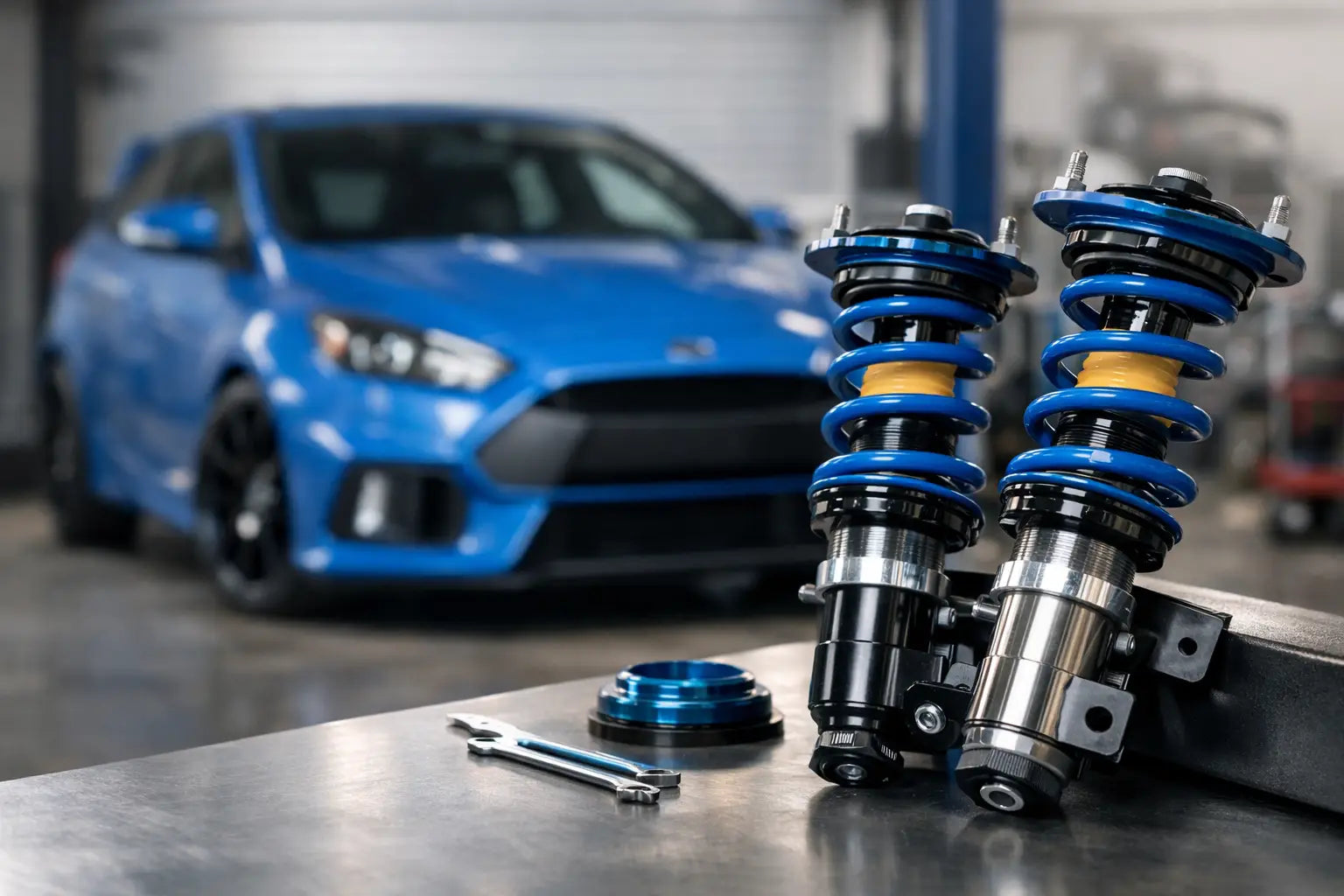
If you are figuring out how to choose Ford RS coilovers, the wrong starting point is price. The right starting point is how the car is actually used. A Focus RS built for damp B-roads needs a very different suspension setup from one chasing lap times, running sticky tyres and carrying aggressive alignment. Coilovers are not just a styling part that drops the ride height - they change the way the whole car loads up, rotates, rides kerbs and puts power down.
That matters even more on an RS. These cars are quick, heavy enough to punish bad suspension choices, and sensitive to setup quality. Get it right and the car feels sharper, calmer and more connected. Get it wrong and you end up with a crashy ride, poor traction and a car that looks serious but drives worse.
How to choose Ford RS coilovers for your build
The first question is not which brand badge you want in the wheel arch. It is whether your car is road-biased, fast-road, or track-led. Most owners say they want “a bit of both”, but the split matters. A car that spends 90 per cent of its life on the road should not be set up like a circuit tool, even if it sees the occasional track day.
For a mainly road-driven RS, focus on ride quality, corrosion resistance and sensible damping control. You want compliance over broken surfaces, not a setup that fidgets over every ridge and tramlines across cambers. For fast-road use, a firmer spring and damper package can work brilliantly, but it still needs enough travel to cope with real British roads.
If the car is genuinely track-focused, priorities shift. Heat management in the dampers, adjustment range, support under heavy load and compatibility with track alignment become more important than comfort. A proper track setup can feel incredible at speed, but there is always a trade-off. More control often means more noise, more harshness and less forgiveness on rough roads.
Ride height is only part of the story
A lot of people shop for coilovers as if the drop is the product. It is not. Ride height matters for appearance and centre of gravity, but damper quality is what decides whether the car feels planted or nervous.
Dropping the car too far can hurt more than it helps. You reduce suspension travel, alter geometry and can push the car into bump stop too easily. On a Ford RS, that can leave the front end skittish and the rear less predictable when the road gets rough. A moderate drop with well-controlled damping usually delivers more real pace than an ultra-low setup chosen for looks alone.
The best systems give you usable ride height adjustment without ruining the car’s geometry window. That means enough adjustment to get the stance right, while keeping the suspension working properly. Built for speed means nothing if the car spends every B-road section bouncing off its own limits.
Spring rates and damping decide how the car feels
This is where many buying decisions are won or lost. Spring rate affects how much the car resists compression and weight transfer. Damping controls the speed of that movement. Too stiff on springs and the car can skip across poor surfaces. Too soft on damping and it can feel loose, floaty or under-controlled.
For road and fast-road RS builds, balanced spring rates are usually the smarter choice than chasing the stiffest setup available. British roads reward suspension that can breathe. If the tyre cannot stay in contact with the surface, grip disappears no matter how serious the kit looks on paper.
Damping adjustability can be useful, but only if it is meaningful. A quality one-way adjustable kit is often a better buy than a cheaper multi-adjustable setup with poor internal valving. More clicks do not automatically mean more performance. Good engineering, consistent damper behaviour and sensible baseline setup matter far more.
If you know the car will evolve over time, adjustable damping makes sense. You can soften it for road miles and add control for circuit work. But if you are never going to tune it properly, a fixed-rate premium kit from a respected manufacturer can be the cleaner solution.
One-way, two-way and top mounts
One-way adjustable coilovers normally change rebound and compression together in a pre-set relationship. For most enthusiasts, that is enough. They are simpler, easier to set up and less likely to be misadjusted.
Two-way systems separate rebound and compression, which gives more control for experienced owners or dedicated track cars. The upside is precision. The downside is complexity. If you do not understand what each change is doing, it is easy to make the car worse rather than better.
Top mounts are another key decision. Pillowball or solid top mounts can sharpen steering response and improve precision, but they often add noise and vibration. Rubber top mounts are quieter and more civilised. Again, it depends on the brief. A daily-driven RS and a weekend time-attack style build do not need the same compromise.
Do not ignore corrosion resistance and long-term use
UK weather is hard on suspension. Salt, grime and moisture can destroy cheap threaded bodies and seized collars turn “fully adjustable” into “stuck forever”. If the car sees year-round use, material quality matters just as much as outright performance.
Look for coated or stainless bodies, durable spring finishes and hardware that will survive winter conditions. A bargain kit that corrodes after one season is not a bargain. Premium coilovers tend to cost more because the engineering, materials and internal tolerances are better. That pays off in damper consistency, service life and the ability to actually adjust the setup six months later.
This is especially important if you plan to corner-weight the car or refine ride height over time. Precision installation starts with parts that still move when you need them to.
Fitment matters more than generic claims
Ford RS owners should be careful with broad “fits Focus platform” language. Not every setup suits every generation, and not every kit is tuned equally for RS weight, drivetrain and use case. A Mk2 Focus RS has different demands from a Mk3 Focus RS, especially once wheel and tyre specs, power levels and intended use come into play.
That means checking proper vehicle-specific fitment, not guessing based on appearance or shared chassis assumptions. Brake clearance, top mount design, drop range and damper tuning all need to align with the exact model. If the car runs aftermarket wheels, wider tyres or other chassis upgrades, that can influence what works best too.
A serious suspension upgrade should be chosen as part of the package. Tyres, alignment, anti-roll bars and even bush condition all affect the result. Coilovers cannot fix worn mounts, tired links or poor geometry.
Think about the rest of the chassis
An RS on excellent coilovers but poor tyres will still feel compromised. Likewise, fitting aggressive suspension without a proper alignment leaves performance on the table. Camber, toe and ride height all interact. Once coilovers are installed, the geometry needs setting for the car’s real use, not just returned to a generic factory-like number.
If you are planning other upgrades, choose coilovers that leave room to grow. A setup that works with uprated top mounts, better anti-roll bars or future track alignment can save money later. Engineered upgrades should work together, not fight each other.
Budget smart - but do not buy twice
There is a reason the market spans from entry-level kits to motorsport-grade systems. The jump in price usually reflects damper quality, adjustment accuracy, corrosion resistance and development depth. For many owners, the sweet spot sits in the middle to upper-middle tier - good enough to transform the car properly without stepping into race-only complexity.
If your budget is tight, it is better to wait and buy a well-developed kit than rush into the cheapest option available. Cheap coilovers often look the part at first, but long-term they can bring poor ride quality, inconsistent damping and expensive regret. Buying once is usually cheaper than buying twice.
That does not mean the most expensive option is automatically the right one. A premium two-way kit for a road car can be overkill. Spend where it changes the driving experience, not where it only adds specification sheet bragging rights.
The right coilovers make the RS feel complete
When people ask how to choose Ford RS coilovers, what they usually mean is how to avoid wasting money on the wrong setup. The answer is to be honest about the car’s job, choose damper quality over gimmicks, keep the ride height sensible and buy for your platform, not for generic hype.
A well-chosen coilover kit should make the RS feel tighter, faster and more confidence-inspiring without stripping away what makes the car enjoyable on real roads. That is the target. If you build around that, the right suspension will not just change the stance - it will change the whole way the car attacks the road.
Share:
Focus ST vs Focus RS: Which One Fits You?
Ford ST Upgrade Guide for Fast Road Builds