
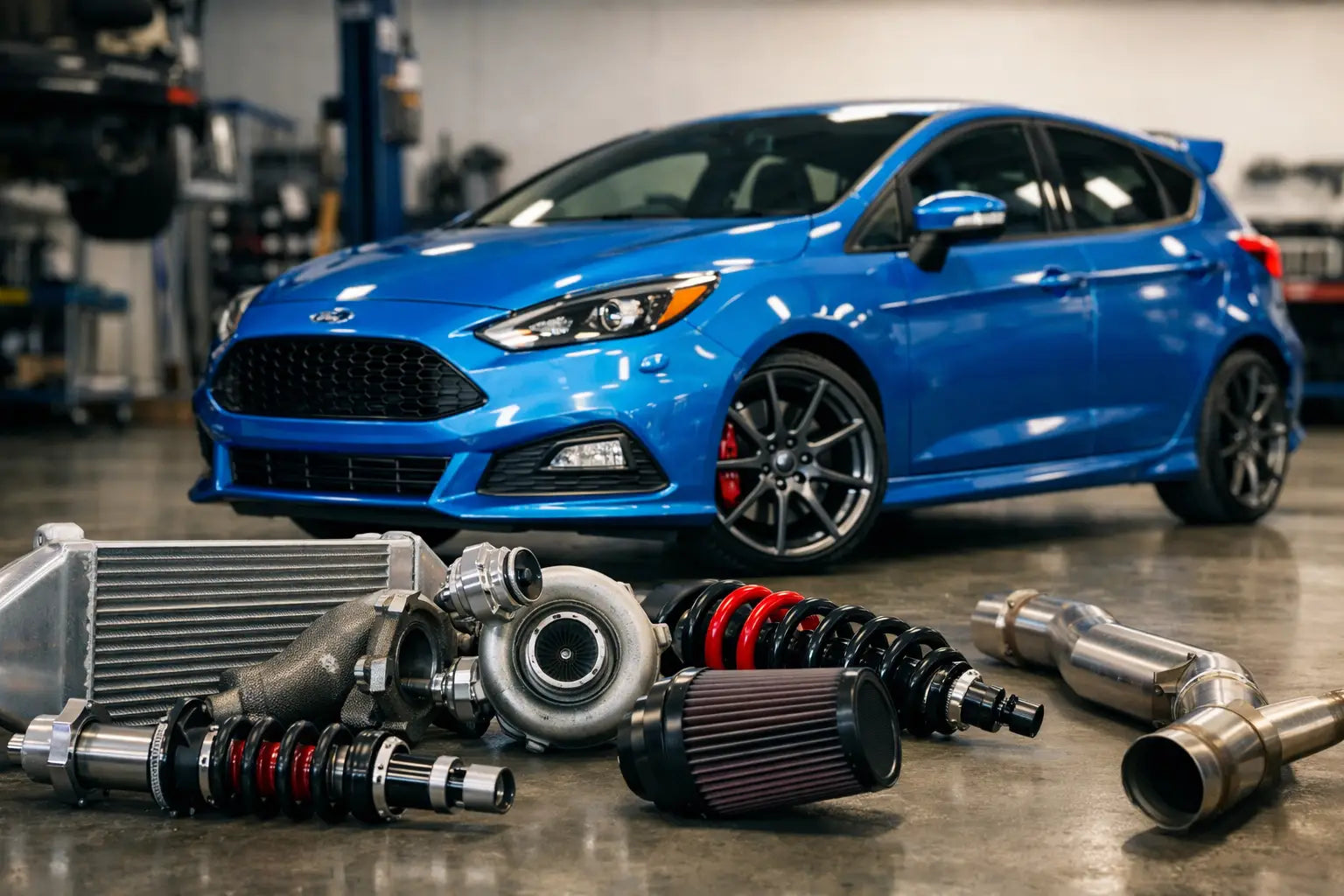
A quick Ford ST can feel brilliant on the first hard pull, then start showing its weak points the moment you really lean on it. Heat soak, axle tramp, vague front-end control, soft factory bushings - it all appears once the pace rises. That is exactly why a proper Ford ST upgrade guide matters. The best builds are not just louder or lower. They are balanced, repeatable and engineered to work together.
If you own a Fiesta ST or Focus ST, the temptation is always to chase peak bhp first. Fair enough - turbo Fords respond well, and a simple calibration can wake the car up immediately. But if the chassis cannot put power down cleanly, or the brakes wilt after a few hard stops, you have built a dyno figure, not a sharper car. Fast road and track-ready ST builds are won by order, not just by parts.
Ford ST upgrade guide - start with your goal
Before buying anything, decide what the car needs to do. A daily-driven Fiesta ST commuting through town and seeing the odd B-road blast needs a very different setup from a Focus ST doing regular track sessions. One wants sharper response without ruining ride quality. The other can accept more noise, more firmness and more maintenance in return for consistency.
Budget matters too, but not in the obvious way. Cheap parts bought twice cost more than doing it properly once. On ST platforms especially, fitment, material quality and heat management separate the good upgrades from the forgettable ones. Motorsport thinking pays off here - every part should solve a problem, not just fill a shopping basket.
Power upgrades that make sense
The easiest win on most ST models is a well-developed ECU calibration, but it should never be treated as a standalone miracle. A map on a standard car can deliver a noticeable lift in torque and urgency, yet the supporting hardware determines whether that extra output stays consistent or fades after a few hard miles.
Intake and intercooler first, not just for noise
An induction kit is popular because you hear the turbo more clearly, but the real conversation should be about airflow and temperature control. Some intake setups sound excellent but offer limited gains if the rest of the system is restrictive. A properly designed intake paired with a more efficient intercooler is a smarter move. Lower charge temperatures help the car hold performance run after run, particularly on warm days or during repeated acceleration.
On a road car, that means stronger consistency rather than one good pull. On track, it can be the difference between confidence and frustration. Heat is the enemy of turbo performance, and ST owners feel that quickly once they start increasing boost.
Exhaust and downpipe - useful, but only with a plan
A freer-flowing cat-back exhaust improves character and can reduce back pressure, but by itself it rarely transforms the car. The bigger gains often come when combined with a sports cat or downpipe and matched software. The trade-off is obvious - more noise, a stronger smell in some cases, and potentially more cabin drone depending on the setup.
For a daily, that matters. What sounds aggressive for ten minutes can become tiresome on a motorway run. The right choice depends on whether your car is built for theatre, lap times or both.
Chassis upgrades are where an ST comes alive
Ford gave the ST range a strong base, which is why these cars respond so well to focused suspension and geometry work. If you want the car to feel faster everywhere rather than only in a straight line, start here.
Springs and coilovers
Lowering springs can sharpen the stance and reduce some body movement, but they are always a compromise if used with dampers that were not designed around them. For owners wanting a modest fast-road improvement, quality springs can work well. For anyone pushing harder, a properly matched coilover kit offers better damping control, better support under load and far more adjustability.
That does not mean every ST needs an ultra-stiff setup. In fact, many road cars are ruined by suspension that is too harsh for the roads they actually drive on. British roads are not billiard tables. A fast car that skips across broken surfaces is slower and less enjoyable than one that keeps the tyre loaded.
Bushes, mounts and anti-roll bars
This is where many ST builds gain the precision people were hoping for all along. Uprated engine mounts can reduce drivetrain movement and sharpen shifts, especially on more powerful setups. The downside is increased vibration at idle and low speed. Some owners will accept that happily. Others will hate it within a week.
Anti-roll bars and upgraded bushes can tighten the car significantly, helping it hold a line better and respond more cleanly to steering input. Done properly, these changes make the car feel more serious without necessarily chasing huge spring rates. On front-wheel-drive ST platforms, getting the front end to bite and the rear to rotate progressively is worth more than bragging rights.
Brakes deserve more respect than they get
There is no point adding power if the braking package remains an afterthought. Standard ST brakes can be decent on the road, but once speed rises and use becomes more aggressive, limitations show up quickly.
A high-quality pad and disc package is often the smartest first step. Pair that with braided lines and proper fluid, and pedal feel improves immediately. For many fast-road cars, that is enough. If you are regularly doing track days, a larger brake setup may be worth it, especially for thermal stability.
This is one area where the glamorous option is not always the first one to buy. A big brake kit looks right behind the wheel, but if your tyres are average and your fluid is old, you have missed the basics.
Wheels and tyres - the upgrade you feel every metre
Nothing changes an ST more honestly than tyres. More grip, better sidewall support and stronger wet-weather performance all feed directly into acceleration, braking and cornering. It is not the flashiest spend, but it is one of the most effective.
Wheel choice matters too. Reducing unsprung mass can improve response and ride quality, but only if the wheel is genuinely lighter and strong enough for the job. A heavier oversized wheel can blunt the car. Chasing looks alone often works against performance.
On a Ford ST, sensible width and tyre pairing usually deliver better results than forcing the most aggressive fitment possible. Rubbing, tramlining and compromised steering feel are not signs of a sorted build.
Do not ignore airflow and cooling
Once power climbs, reliability becomes part of the performance conversation. Better cooling is not a glamorous topic, but it protects your investment and preserves repeatability. Intercoolers are the headline item, yet radiator upgrades, oil cooling on harder-used cars, and sensible ducting can all matter depending on how the car is driven.
This is where engineering-led parts stand apart from generic alternatives. Properly developed components built around accurate fitment, airflow management and real use conditions tend to outperform parts that are sold purely on appearance.
Styling upgrades should still earn their place
There is nothing wrong with wanting your ST to look sharper. These cars wear aggressive styling well, especially when carbon fibre parts, aero details and clean body enhancements are used with some restraint. The key is keeping the build cohesive.
A splitter, spoiler extension or carbon detail should complement the car’s purpose, not fight it. Poorly fitted styling parts cheapen the whole vehicle. Precision matters here just as much as it does under the bonnet. The strongest visual builds look engineered, not random.
For enthusiasts who care about both form and function, that is where specialist development pays off. Parts shaped through proper design work and platform knowledge always look more convincing than off-the-shelf add-ons that happen to fit.
The smartest order for a fast-road ST
If you are building in stages, start with tyres, brakes and an intercooler if the model is known to suffer with heat. Then add a proven intake and calibration. After that, move into suspension, mounts and geometry. Exhaust upgrades can be added where they fit your goals, and cosmetic changes can follow once the driving experience is already where it should be.
That order is not glamorous, but it works. It gives you a car that gets quicker in a usable way, rather than one that feels impressive in a social media clip and frustrating everywhere else.
For owners who want parts selected with actual platform knowledge behind them, 150 Performance sits firmly in that specialist lane - performance-led, fitment-aware and aimed at drivers who care about the result, not just the label.
Ford ST upgrade guide - what to avoid
The biggest mistake is chasing a single headline figure. Peak power sells. Balanced performance keeps the car enjoyable. Another common error is mixing random components without thinking about how they interact. A stiff rear end, bargain tyres and an aggressive map can make an ST feel lively for all the wrong reasons.
The other trap is forgetting how you really use the car. A road-driven ST should not be set up like a stripped track toy unless you are happy to live with the downsides every day. Noise, harshness, tyre wear and maintenance all rise as performance rises. That is not a problem if you chose it deliberately. It is a problem if you did not.
Build your ST with intent. Choose parts that solve the next real limitation, not the loudest one. That is how you end up with a Ford that feels fast every time you drive it, not just when someone asks what has been done to it.
Share:
How to Choose Ford RS Coilovers
Best Ford Fiesta ST Upgrades That Matter