
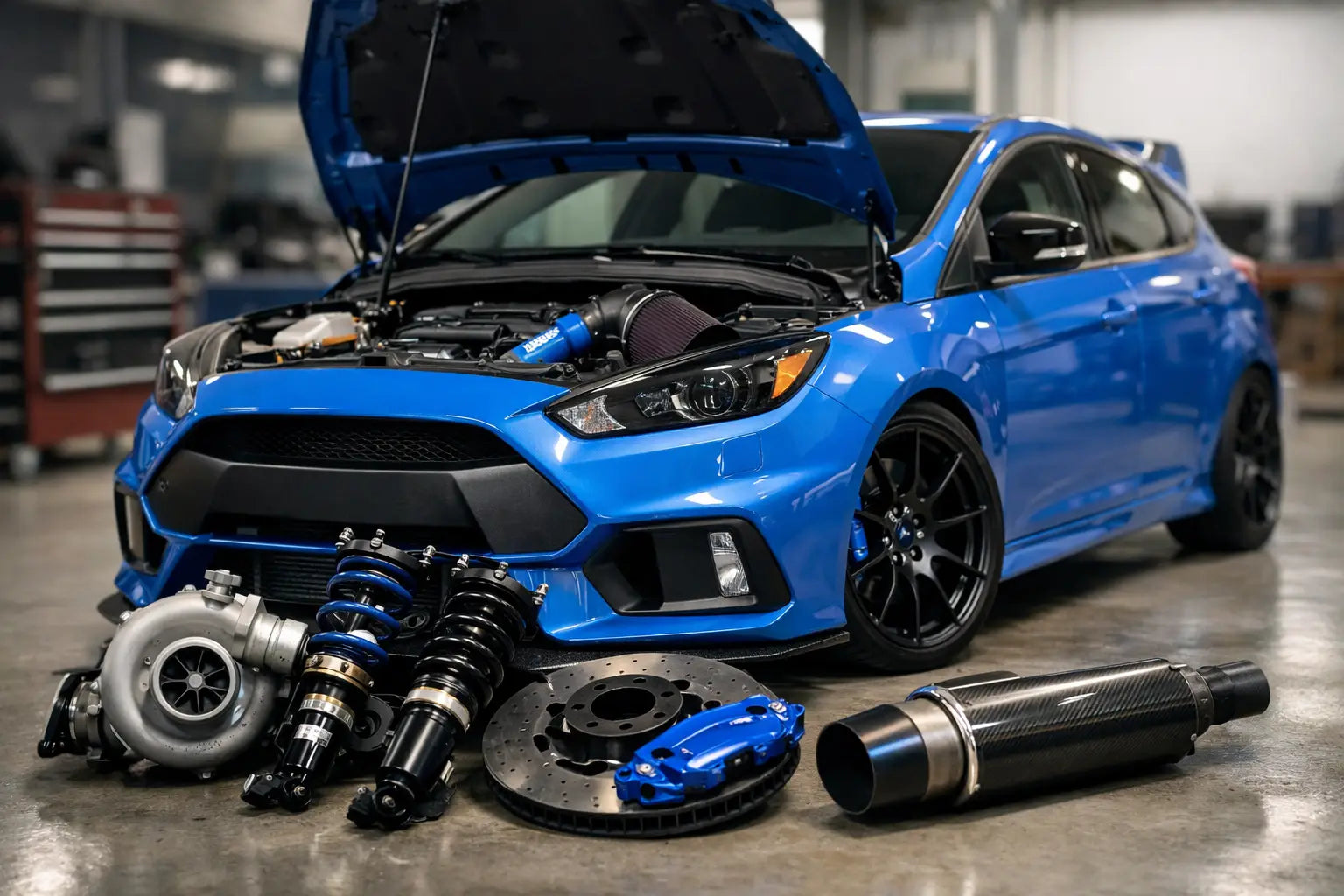
A standard Focus RS is quick enough to make a back road feel short and a track day feel expensive. But anyone who has spent real time with one knows the factory package still leaves room on the table. The right Ford RS upgrades do not just add noise or headline power. They sharpen response, control heat, improve confidence and make the car feel more resolved when you actually lean on it.
That is the difference between modifying for social media and upgrading with purpose. On an RS, every part affects something else. More boost asks more from cooling. More grip exposes weaknesses in suspension setup. More aggression in the exhaust can be brilliant on a Sunday blast and tiring by Wednesday morning. If you want a car that feels fast, balanced and engineered rather than just modified, the order of upgrades matters.
Ford RS upgrades that change the car properly
The biggest mistake RS owners make is chasing power first because it is the easiest number to talk about. In reality, the first upgrades that usually transform the car are the ones that improve how it breathes, manages temperature and puts power down.
A quality intake and intercooler package is often where the conversation should start. The stock car can feel strong in cool conditions, but repeated hard use highlights heat soak quickly. Better charge cooling keeps performance more consistent, especially if the car sees fast road driving in summer or regular circuit work. Pair that with a properly developed intake setup and you improve response without creating a car that feels peaky or awkward in traffic.
From there, an exhaust upgrade makes sense, but only if you are honest about how the car is used. A well-engineered system reduces back pressure, improves tone and can support future tuning. A badly chosen one just drones on the motorway and turns every cold start into a negotiation with the neighbours. For a road-driven RS, sound quality matters as much as outright volume.
Then there is calibration. A remap can deliver serious gains on the RS platform, but it only makes sense when the supporting hardware is there and the tune is written with the actual setup in mind. Flashing in aggressive figures without thinking about fuel quality, cooling and drivability is how people end up with a car that feels exciting for one pull and compromised everywhere else.
Start with chassis before chasing big numbers
The Focus RS is already a capable chassis, which is why suspension changes need a bit of restraint. Not every owner needs a super-stiff track setup, and not every lowering spring is an upgrade just because the arch gap disappears.
Suspension and geometry
If you want the car to feel tighter, more accurate and more confidence-inspiring, start by looking at dampers, springs and alignment as a complete package. Good-quality coilovers or a matched spring and damper setup can make the front end bite harder and the rear feel more controlled under load. But poor damping on rough British roads will make the car skittish, and a car that skips over cambers is not fast, however aggressive it looks parked up.
Geometry is where a lot of hidden performance lives. A proper alignment suited to your wheel, tyre and ride height setup can make a bigger real-world difference than plenty of bolt-on parts. Turn-in, mid-corner stability and traction on corner exit all improve when the settings are right. It is not glamorous, but it is one of the smartest upgrades you can make.
Brakes and tyre choice
Brakes are another area where sensible upgrades pay off immediately. If the car is seeing harder use, better pads, uprated fluid and braided lines can transform pedal feel and consistency. For many owners, that is enough. A full big brake kit looks the part and can be a genuine step up, but it is not always essential unless power, pace and track time are all increasing together.
Tyres deserve the same respect. They are not a finishing touch. They are the foundation. A strong tyre choice can make the RS feel sharper, calmer and faster in every condition. If the budget is going anywhere early on, tyres should be near the front of the queue.
Engine and cooling upgrades for usable performance
The RS responds well to engine tuning, but usable performance always beats a dyno graph. Fast road and track builds need to survive repeated abuse, not just one clean run.
Cooling first, then power
Cooling upgrades are rarely the parts people post about first, but they are often the ones that protect the rest of the build. Intercoolers, uprated radiators and oil cooling solutions help the car maintain output when temperatures rise. That matters on track, in traffic after a hard run, and during the kind of back-to-back driving that exposes weak setups quickly.
Once cooling is sorted, power upgrades have a stronger foundation. Intake, exhaust and software can work together to deliver a broader, cleaner powerband. The best RS builds are not always the ones with the highest peak figure. They are the ones that pull hard, repeatably, and still feel crisp after twenty minutes of punishment.
Drivetrain support
As torque rises, drivetrain upgrades become harder to ignore. Mounts, clutches and supporting hardware can all start to matter depending on the power target. The trade-off is refinement. Stiffer mounts can improve response and reduce drivetrain movement, but they can also add vibration into the cabin. Some owners are happy with that. Others regret it after a week of commuting.
That is the pattern with most Ford RS upgrades. The best choice depends on how much compromise you are genuinely willing to live with, not how committed you feel while browsing parts at midnight.
Carbon fibre and aero - not just for looks
There is nothing wrong with wanting your RS to look more aggressive. It is part of the appeal. But on a properly built car, carbon fibre and aero parts should do more than add visual drama.
A well-made carbon fibre bonnet, spoiler element, splitter or diffuser can reduce weight, improve airflow management and sharpen the overall motorsport feel of the car. Fit and finish matter here. Poorly made carbon parts can ruin panel gaps, introduce vibration and look tired far too quickly. Precision matters, especially on a car with strong factory lines.
This is where specialist product development separates engineered upgrades from generic accessories. Parts developed with scanning, CAD design and platform-specific fitment in mind tend to install better, last longer and look like they belong on the car. That matters whether the goal is weight reduction, visual impact or both.
Choosing Ford RS upgrades for your type of driving
Not every RS build should end up in the same place. A fast road car, a weekend show-and-go setup and a track-focused machine all need different priorities.
For a road-biased build, the sweet spot is usually intake, intercooler, exhaust, remap, quality tyres and a carefully chosen suspension package. That keeps the car exciting without making it tiring. It is quick, responsive and still usable.
For a track-led setup, cooling, brakes, alignment and tyre strategy move further up the list. Consistency matters more than noise. Heat management matters more than social-media-ready pops and bangs. If the car is doing real laps, reliability becomes part of performance.
For owners chasing a stronger visual statement, carbon fibre exterior parts and carefully selected stance upgrades can change the whole presence of the car. Just do it without ruining function. An RS that looks serious should still drive like one.
Buy parts with a plan, not just a wishlist
The RS aftermarket is full of tempting options, and not all of them deserve your money. The smartest route is to build around a clear target. Decide whether the car needs to be sharper, faster, more durable under hard use, or more visually focused. Then choose parts that support each other.
That is why specialist retailers matter. A brand that understands Ford platforms, fitment, materials and real-world performance can help you avoid wasting money on parts that fight each other. At 150 Performance, that engineering-first mindset is exactly what separates a serious upgrade path from a random basket of shiny parts.
The best Ford RS upgrades are the ones that make the whole car feel more complete. Not harsher for the sake of it. Not louder because louder sells. Just faster, tighter and better sorted every time you get behind the wheel.
If you are building an RS, build it with intent. The right parts do more than change the spec sheet - they change how the car feels when the road opens up and you finally get to use it properly.
Share:
Ford ST tuning guide for fast road gains
Focus ST vs Focus RS: Which One Fits You?