
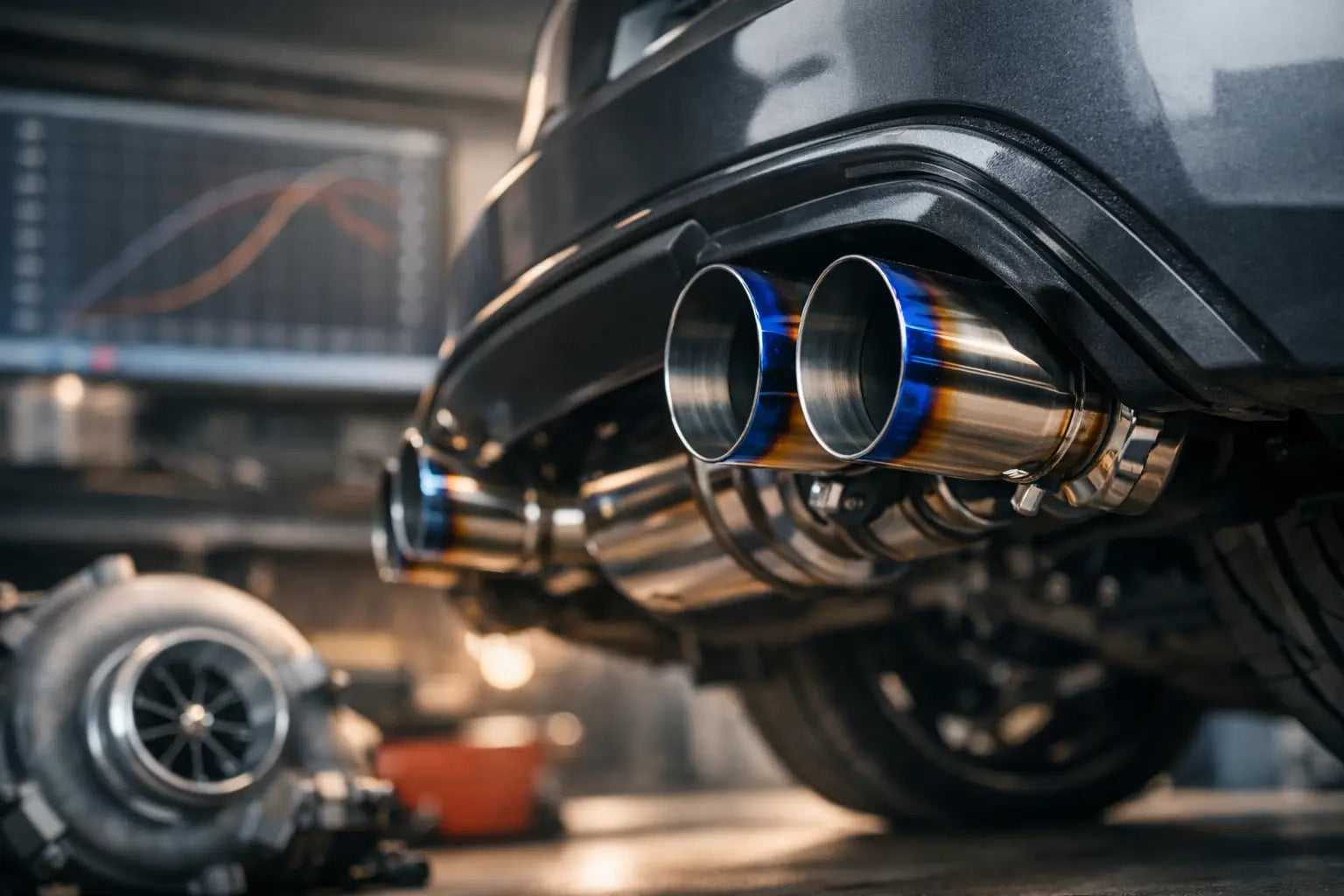
Ask any enthusiast why they want a new exhaust and you will usually hear the same answer first - sound. Fair enough. But the real question is whether do performance exhausts increase power, or whether the extra noise just makes the car feel faster. The honest answer is yes, they can increase power, but not every system does, and not every car responds in the same way.
That matters if you are building a fast road car, a track machine, or simply trying to get more from your ST, RS or Mustang without wasting money on parts that only change the soundtrack. Exhaust upgrades work when they improve flow without upsetting the rest of the engine package. Get it right and you can free up horsepower, sharpen response and reduce weight. Get it wrong and you can spend a lot for very little beyond a louder cold start.
Do performance exhausts increase power on every car?
No, and this is where a lot of exhaust marketing gets over-simplified. A performance exhaust is not a magic bolt-on that guarantees a big bhp jump. It is one part of the engine's breathing system. The engine pulls air in, burns fuel, then pushes spent gases out. If the standard exhaust is restrictive, improving that exit path can absolutely help the engine make more power. If the factory system already flows well, the gains may be modest.
Turbocharged cars and naturally aspirated cars also react differently. On a turbo platform, reducing post-turbo back pressure often helps the turbo work more efficiently. That can improve spool, response and top-end pull. On a naturally aspirated engine, exhaust tuning is more sensitive. Pipe diameter, silencer design and overall exhaust-gas velocity matter a lot. Too large an exhaust can actually hurt low-down torque.
So yes, performance exhausts can increase power, but the useful phrase is this: they increase power when the standard system is the bottleneck.
Where the power gains actually come from
A proper exhaust upgrade is about exhaust-gas flow, not just volume. The standard exhaust on many performance cars is designed around cost, emissions, refinement and packaging. Manufacturers are balancing noise regulations, production budgets and broad customer expectations. That leaves room for improvement, especially on enthusiast platforms with tuning potential.
A better-designed system can reduce restriction through smoother bends, better collector design, less restrictive silencers and a more efficient catalytic setup where legal and appropriate. On turbo cars, this usually means the turbo sees less resistance after the turbine. That can help it build and hold boost more effectively. On the road, that often feels like cleaner mid-range and less effort at higher revs.
Weight reduction is another overlooked gain. Some aftermarket systems drop a useful amount of mass compared with the OE exhaust, particularly if the replacement uses high-grade stainless steel or titanium. That does not create horsepower on a dyno sheet, but it improves the car's overall performance profile. Less weight, especially rearward weight, is never a bad thing on a performance build.
Cat-back, axle-back and downpipe differences
Not all exhaust upgrades are chasing the same result. An axle-back system mainly changes the rear section. It is often chosen for sound and appearance, and while it may save weight, power gains are usually limited.
A cat-back system replaces more of the exhaust path from the catalytic converter backwards. This can offer better flow than an axle-back and may deliver small but measurable gains, especially if the factory cat-back is restrictive.
On turbocharged cars, the biggest gains often come from the downpipe or front section because that is where flow restriction matters most. Pairing a freer-flowing downpipe with an ECU calibration can transform how the car delivers power. That is why some owners fit a cat-back expecting major bhp gains and end up disappointed. They upgraded the least restrictive part first.
How much power can you realistically expect?
This depends entirely on the platform, the exhaust design and whether the car is tuned. On an otherwise standard turbo hot hatch, a cat-back alone may add only a small amount of power - sometimes barely noticeable on paper. You may feel improved response and hear a more aggressive note, but the dyno result could be modest.
Add supporting mods and calibration, and the story changes. Once intake flow, boost control and fuelling are optimised, the exhaust becomes a more meaningful restriction point. At that stage, a properly engineered system can support stronger gains and help the whole package work harder, especially at the top end.
On naturally aspirated cars, gains are often smaller than owners hope unless the system is part of a full package that includes manifolds, intake improvements and mapping. The reward is usually not just peak power but a better spread of performance and a sharper, more urgent character.
That is the key distinction. A good performance exhaust does not always add headline numbers, but it can improve the way the engine breathes and delivers its power.
Why bigger is not always better
This is where real engineering separates quality parts from generic noise-makers. Exhaust diameter needs to suit the engine's airflow demand. Too small and you create restriction. Too large and you can reduce exhaust-gas speed, hurting scavenging and low-rev drivability.
That is why platform-specific design matters. A system built around proper development, measured fitment and real-world testing is far more likely to deliver than an off-the-shelf universal setup chasing nothing but aggressive sound. The best systems are engineered for the car's power band, turbo characteristics and intended use, whether that is fast road, occasional track work or a more serious motorsport build.
For owners of performance Fords in particular, this matters. A Focus ST, Focus RS or Mustang responds best to parts designed around that chassis and engine, not a one-size-fits-all guess. Precision fitment, sensible pipe sizing and proper silencer tuning make the difference between a car that feels alive and one that drones on the motorway while giving away torque.
Sound can trick you - but feel still matters
There is a reason so many drivers swear a new exhaust made the car faster. Sometimes it did. Sometimes the sharper, louder note simply changes your perception of speed. A more aggressive exhaust makes throttle inputs feel more dramatic and can make the engine seem keener, even if the actual gain is small.
That does not mean the upgrade is pointless. Driving experience matters. If the car sounds harder-edged, feels more responsive and has cleaner pull through the rev range, that is still a worthwhile result. Enthusiast modifications are not only about peak dyno numbers. They are about making the car feel more special every time you drive it.
Still, if your only goal is power per pound, it pays to be realistic. Exhausts are often best viewed as part of a performance package rather than the single mod that changes everything.
The trade-offs you should know before buying
A proper exhaust upgrade usually brings compromises, and serious enthusiasts are better off knowing them upfront. More flow and more sound often mean more cabin presence. Some systems drone at cruising speed. Others are fine on a weekend blast but tiring on long motorway runs.
There is also legality and emissions to consider. Depending on the setup, changing catalysts or removing emissions equipment can create MOT issues and road legality problems. For a road car in the UK, that is not a minor detail. The smartest route is choosing a system that matches how the car is actually used.
Heat management matters too, particularly on harder-driven turbo cars. Better exhaust flow can help performance, but surrounding components still need proper protection. Cheap systems also have a habit of poor fitment, weak welds and rattles that turn an exciting upgrade into a constant irritation.
This is exactly why serious buyers gravitate towards specialist suppliers and properly engineered kits. The right exhaust should fit cleanly, perform consistently and hold up under real use.
So, do performance exhausts increase power enough to be worth it?
If you choose the right system for the right car, yes. On a restrictive factory setup, especially on a turbocharged platform, a performance exhaust can absolutely support more power, better response and a harder-edged delivery. If you are expecting dramatic gains from a rear section alone on a well-optimised standard car, probably not.
The smartest way to think about an exhaust is as a performance enabler. It helps the engine breathe, supports future tuning and changes the character of the car in a way few other mods can. The best results come when it is part of a matched setup, not a random bolt-on chosen only for tailpipe style or internet noise clips.
For enthusiasts who care about engineering as much as attitude, that is the whole point. Buy an exhaust because it is designed properly, sized correctly and built to suit your platform. Then the extra power, the sharper response and the soundtrack all start working in the same direction.
If you are modifying with intent rather than just chasing noise, that is where an exhaust upgrade earns its place.
Share:
How to Prepare a Track Day Mustang
How to Upgrade Focus RS Brakes Properly