
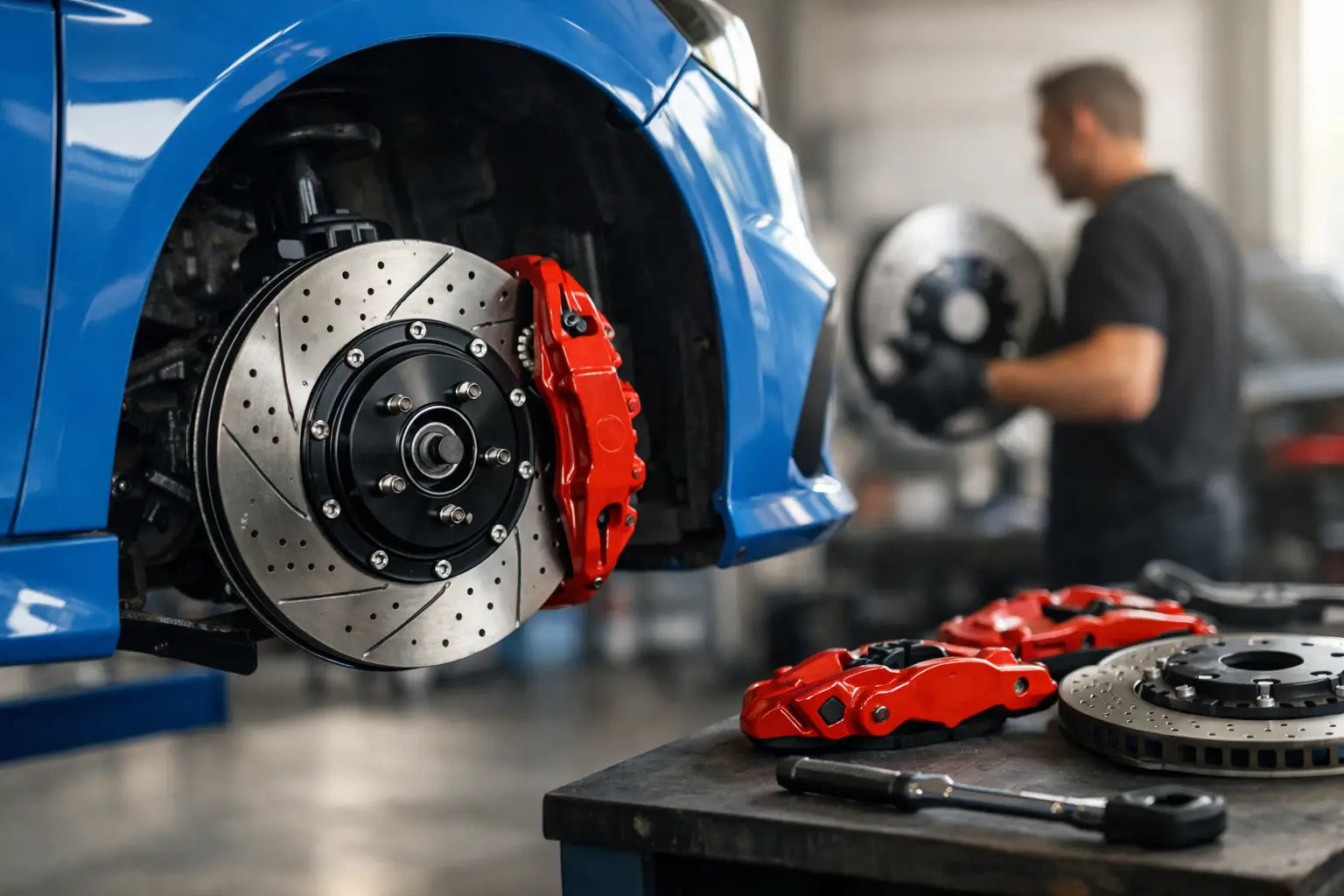
A Focus RS on factory brakes can feel strong right up until you start asking proper performance-car questions of it. One hard B-road run is fine. Repeated late braking on a fast road or a track session is where you find the limit. If you are looking into how to upgrade Focus RS brakes, the smart move is not throwing the biggest kit you can afford at the car - it is building a brake package that matches how you actually drive.
The RS is heavy, fast, four-wheel drive and capable of carrying serious speed into a braking zone. That means heat management matters just as much as outright stopping power. Plenty of owners chase bigger calipers when the real issue is pad compound, fluid temperature, tyre grip or inconsistent pedal feel. Built for speed means engineered for precision, and brakes are one area where the details make all the difference.
How to upgrade Focus RS brakes without wasting money
The best upgrade path depends on whether your car is mainly a fast-road machine, a dual-purpose road and track build, or a more serious circuit-focused setup. For most owners, the standard Brembo front calipers are not the weak point. They are a solid base. What usually lets the system down first is heat in the pads and fluid, followed by disc wear if the car is driven hard and often.
That is why a staged approach makes sense. Start with the parts that improve consistency, confidence and heat resistance. Then move to larger hardware only if your use case demands it. A well-chosen pad and fluid setup on the factory calipers can transform the car far more than most people expect.
Start with the real weak points
Brake pads change the car more than most people realise
Pads are usually the first proper upgrade, and for good reason. The factory compound is fine for mixed everyday use, but once temperatures rise, pedal feel and bite can go away quicker than you want. A performance road pad will sharpen initial response and improve confidence without making the car miserable in traffic. If you do regular track days, step up to a pad designed to live at higher temperatures.
There is always a trade-off. More aggressive compounds usually bring more dust, more noise and sometimes less refinement when cold. That is normal. The right choice comes down to how much compromise you can live with. If the car sees school runs and commuting, go for a fast-road or road-and-track compound. If it is trailered to track events or driven hard every month, a more focused pad will make sense.
High-temperature brake fluid is not optional
A soft pedal after a few hard laps is often fluid-related, not caliper-related. Standard fluid simply cannot cope with repeated heat cycles in the same way a proper high-performance fluid can. Upgrading fluid is one of the cheapest and most effective ways to improve brake consistency.
It is also one of the most overlooked. Enthusiasts will spend heavily on hardware, then leave old fluid in the system and wonder why the pedal goes long. Fresh high-boiling-point fluid, changed at sensible intervals, is basic brake preparation on any fast Ford that sees hard use.
Braided lines improve feel, not magic stopping power
Braided brake lines are worth fitting if you want a firmer, more precise pedal. They reduce expansion under pressure compared with ageing rubber lines, so the pedal often feels cleaner and more direct. What they do not do is create huge extra stopping force on their own.
That matters because brake upgrades are full of exaggerated claims. Braided lines are a feel upgrade and a consistency upgrade. Pair them with better pads and fluid, and the whole system starts to work as one properly sorted package.
Discs matter, but not always in the way people think
When owners talk about bigger brakes, they often jump straight to disc size. Bigger discs can improve thermal capacity and leverage, but disc design matters too. A quality plain or properly grooved performance disc can be a better choice than something drilled purely for looks.
For a fast-road Focus RS, a high-quality replacement disc combined with better pads and fluid is often enough. For regular track work, a disc with improved cooling characteristics and stable metallurgy is the better route. The goal is not just a dramatic appearance behind the wheel. The goal is repeatable braking when the car is hot and the session is not over yet.
If you are replacing discs, think about the full system. Poor bedding-in, cheap pads on premium discs, or aggressive compounds on low-grade discs can all create vibration, uneven deposits and disappointing life. Brake hardware works best when the components are chosen to match.
When a big brake kit makes sense
You do not always need one
A big brake kit looks the part, and on the right build it delivers genuine gains. Larger rotors, stiffer multi-piston calipers and improved heat capacity all help when the car is repeatedly worked hard. But for many RS owners, it is not the first step. If the standard Brembo setup has only ever seen average pads and old fluid, you have not yet found out what it can really do.
You probably do if the car lives on circuit
If your Focus RS sees frequent track days, higher power, sticky tyres and late-braking abuse, a big brake kit starts to make more sense. The heavier and faster the car gets, the more thermal demand you place on the system. At that point, larger hardware is not just about feel or style. It is about control, durability and managing heat lap after lap.
This is also where cheap kits become a false economy. A proper engineered kit should offer correct piston sizing, balanced bias, quality bells and rotors, and sensible pad availability. Fitment and geometry matter. Race-proven design always beats generic catalogue parts.
Rear brakes and balance
The front axle does most of the work, so it is natural to focus there first. Still, rear brakes should not be ignored. Fresh rear discs and pads, good fluid and a healthy handbrake setup all contribute to a stable, confidence-inspiring car. If the rear setup is tired, the whole system can feel less composed under heavy braking.
You do not usually need to chase a huge rear upgrade unless the build is very serious. On most road and track RS setups, a quality service and matched friction materials are enough. The point is balance. You want the car to stay planted and predictable, not just aggressive on initial bite.
Cooling is the upgrade many owners miss
Heat is the enemy of brake performance, so cooling should be part of the conversation. If you are serious about track use, brake ducting or improved airflow can make a noticeable difference to pad life, disc condition and fluid stability. It is not the most glamorous upgrade, but it is one of the most engineering-led.
This is especially true if you are driving long sessions or running the car hard in warmer conditions. Better cooling can help preserve the setup you already have, which often brings more value than replacing parts that were only failing because they were being cooked.
Wheel fitment and tyre grip
Before you commit to larger calipers or discs, check wheel clearance properly. Some kits need spacers, some need different wheel profiles, and some simply will not fit under certain designs. Guesswork is expensive here.
Tyres matter too. More grip means higher braking loads, which can expose weaknesses in the system faster. If you have upgraded to a more capable tyre, the brakes need to keep pace. That does not automatically mean a big brake kit, but it does mean the car should be assessed as a package rather than one part at a time.
A sensible upgrade path for most owners
For most enthusiasts working out how to upgrade Focus RS brakes, the strongest route is simple. Start with performance pads suited to your use, fresh high-temperature fluid, and braided lines if you want a tighter pedal. Add quality discs when replacement time comes or when your current setup is no longer coping. Move to a big brake kit when your driving, tyre choice and heat load genuinely justify it.
That approach keeps the build focused, avoids wasted spend and produces a better car at every stage. It is how serious enthusiasts upgrade - not by chasing the biggest headline spec, but by choosing parts that improve confidence where it matters most.
A fast Ford should feel brutally capable when you stand on the middle pedal, not just when you bury the throttle. Get the brake package right, and the Focus RS becomes sharper, calmer and much harder to outgrow. If you build with purpose, every hard stop feels exactly as it should - fast, stable and fully under your control.
Share:
Do Performance Exhausts Increase Power?
Mustang Aero Parts That Actually Work