
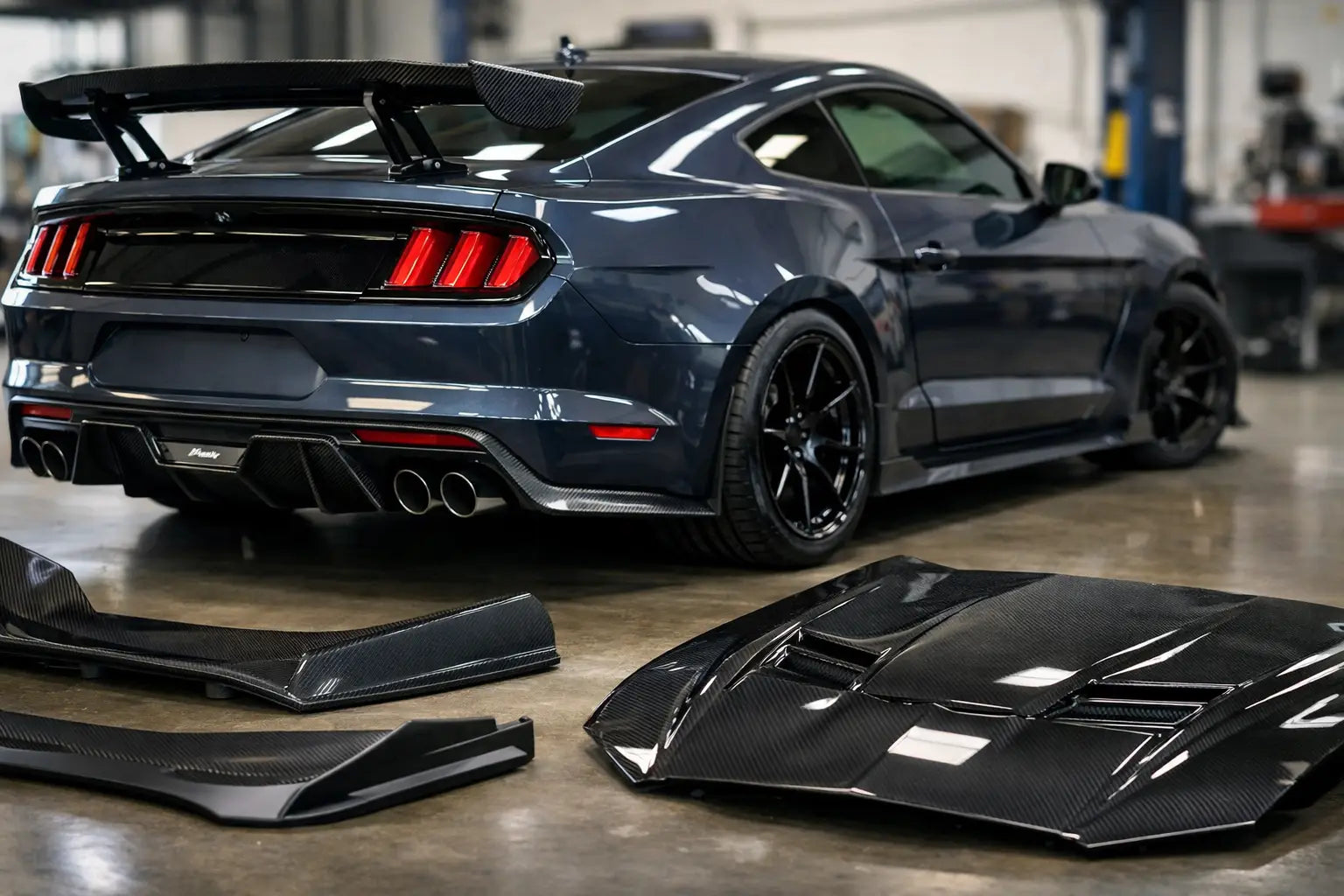
A Mustang at speed tells you very quickly whether the aero is doing a job or just filling space. You feel it through the steering on a fast straight, through the rear end in a committed corner, and under heavy braking when the car needs to stay planted. That is why Mustang aero parts matter. Done properly, they are not just visual add-ons. They are engineered pieces that can improve stability, airflow management and driver confidence.
The key point is simple: not every aero upgrade delivers the same result, and not every Mustang needs the same setup. A road-driven S550 used for fast B-road runs has different priorities from a track car chasing lap time at Donington or Silverstone. The best builds get that balance right.
What Mustang aero parts are really meant to do
Aero parts sit in a strange space because they are some of the most visible upgrades you can buy, but the good ones are built around airflow first. Front splitters, side skirts, rear diffusers, canards, bonnet vents and rear wings all influence how air moves over, under and around the car. The end goal is usually one of three things: more front-end bite, better high-speed stability, or improved airflow and cooling.
On a Mustang, front-end lift is often the first area enthusiasts want to address. The car has presence and power, but once speeds climb, unmanaged air under the nose can start to work against you. A proper front splitter helps control that by reducing the amount of air pushing under the car and increasing pressure management at the front. The result is a nose that feels calmer and more tied down.
At the rear, the story changes slightly. A lip spoiler may tidy airflow and sharpen the shape of the car visually, but a larger rear wing is chasing a different outcome. That kind of setup is aimed at generating meaningful rear downforce, which can help the car stay more stable in fast corners. The trade-off is drag, added cost, and sometimes a setup that feels excessive on a mainly road-driven car.
Choosing Mustang aero parts for road or track
This is where plenty of builds go off course. Owners buy aggressive-looking parts without thinking about how they work together, or whether they suit how the car is actually used.
For a fast road Mustang, a measured aero package usually makes more sense than a full race-style setup. A front splitter, well-designed side skirts and a subtle rear spoiler can improve the car’s stance and aerodynamic behaviour without making it awkward to live with. Ground clearance still matters. So does durability. A part that looks excellent in photos but scrapes on every speed bump will get old quickly.
For a track-focused car, priorities shift. You can justify a more aggressive splitter, larger wing, extra ducting and bonnet venting because the car spends more time at the sort of speeds where aero begins to earn its place. Even then, the setup needs to be coherent. More rear wing without enough front aero can leave the balance wrong. Too much front aero without rear support can create instability where you least want it.
That is the difference between styling and engineering. The strongest builds are developed as a package, not as random individual parts bolted on one by one.
The front end is where many gains start
If you ask most experienced Mustang owners where aero upgrades make the biggest difference, the front of the car is usually the answer. That is because the nose has a major influence on confidence at speed.
A well-designed front splitter can help reduce lift and create a more precise feel from turn-in to corner exit. It also changes the visual attitude of the car, making it look lower, wider and more serious without needing wild body modifications. Carbon fibre versions add another layer of appeal because they combine weight reduction with a premium motorsport finish.
Canards can also play a role, though they are more situation-dependent. On the right car, they can add front-end aero assistance and sharpen the visual aggression. On the wrong car, they become decoration. That does not make them pointless, but it does mean they should be chosen with realistic expectations.
Bonnet vents are another worthwhile area, especially if the car sees hard use. Heat management matters on a powerful Mustang, and venting can help extract hot air from the engine bay while reducing pressure build-up. That can support both cooling performance and front-end aerodynamic efficiency.
Rear aero can transform the car - or overwhelm it
Rear aero is often the first thing people notice, and the easiest place to go too far. A subtle rear spoiler works well on many road builds because it complements the Mustang’s shape and can help tidy the airflow without shouting for attention. It gives the car a sharper finish and often suits owners who want OEM-plus aggression rather than a full competition look.
A larger rear wing is another category entirely. On a track build, it can be a serious performance tool. It can improve rear stability under load and give the driver more confidence in high-speed direction changes. But it only makes sense if the rest of the car supports it. Suspension, tyres, alignment and front aero all need to be considered. Otherwise, the wing becomes a statement piece with limited real-world value.
Rear diffusers sit somewhere in the middle. Their effectiveness depends heavily on the underside airflow and the design itself. Some are largely visual. Others are built with proper airflow management in mind and work best as part of a more complete package. Fitment and finish matter here more than many buyers realise. Poorly designed parts can disrupt airflow and cheapen the rear of the car at the same time.
Material, fitment and finish separate premium from generic
This is the part many buyers learn the hard way. Not all aero parts are made to the same standard, and on a Mustang, poor fitment stands out immediately. Panel gaps, uneven mounting, weak lacquer, flex under load and vague mounting points all turn a promising upgrade into a frustration.
Premium carbon fibre parts earn their price when they are properly developed. That means platform-specific design, accurate contours, reliable mounting and a finish that looks right on the car. Race-proven development methods such as 3D scanning and CAD-led design are not just marketing phrases when they are applied properly. They are the reason a part follows the body line correctly and performs consistently once fitted.
There is also the question of weight. Aero parts alone will not turn a Mustang into a featherweight track weapon, but reducing mass at the extremities of the car can still be worthwhile. Carbon fibre helps here, though the bigger gain is often the combination of weight saving, strength and appearance.
Don’t ignore the rest of the setup
Aero does not work in isolation. If the suspension is tired, the alignment is off, or the tyre choice is wrong, even the best-designed aero package will be held back. This is especially true for owners expecting dramatic changes from bolt-on parts alone.
A splitter and rear wing can increase load on the chassis, but the car still needs the spring rates, damper control and geometry to deal with that load properly. Braking performance also comes into the conversation. If you are carrying more speed with more stability, the rest of the package needs to match.
That is why the best aero upgrades are usually part of a broader plan. Not a shopping spree, but a build direction. If the goal is a sharper fast-road Mustang, keep the package clean and purposeful. If the goal is track performance, build the car around that objective from the start.
Which Mustang aero parts are worth buying first?
For most owners, the strongest starting point is the front splitter. It offers one of the clearest blends of visual impact and functional benefit, especially on S550 and newer cars. From there, side skirts and a well-matched rear spoiler usually make sense, because they complete the look and support the overall airflow package.
If the car sees repeated hard use, bonnet venting is also worth serious attention. Cooling consistency matters on performance builds, and this is one area where style and function often overlap in the best way.
The jump to larger rear wings, canards and more aggressive diffuser setups should come later, once you know how the car is used and what the current setup is lacking. Chasing the biggest part first is rarely the smartest move.
For enthusiasts who care about fit, finish and genuine performance intent, that distinction matters. The right aero parts make a Mustang look faster because they are built with speed in mind. That is the standard serious owners should expect. If a part adds presence, supports airflow and feels right at speed, it has earned its place on the car. If not, keep building until it does.
Share:
How to Upgrade Focus RS Brakes Properly
Ford ST Induction Kit Upgrade Guide