
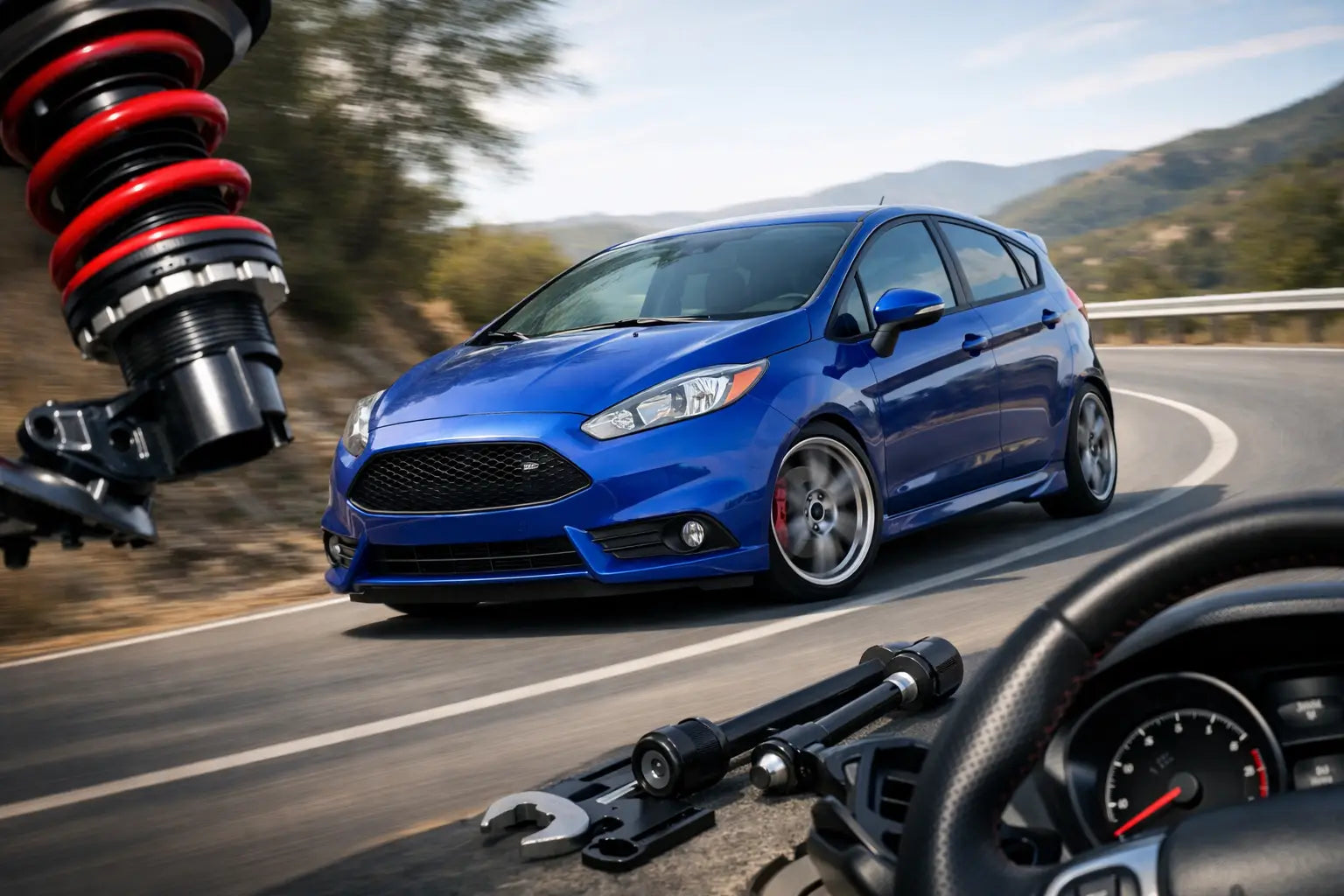
A Fiesta ST can feel razor-sharp one minute and oddly busy the next. Push harder on a rough B-road or through a fast direction change and you quickly find the gap between a good hot hatch and a properly sorted one. If you are wondering how to improve Fiesta ST handling, the answer is not one magic part. It is a package - tyres, geometry, damping, roll control and chassis support all working together.
That matters because the Fiesta ST is already a strong base car. Ford gave it quick responses, a lively rear end and the kind of front-end bite that made the platform famous. The downside is that random bolt-ons can upset that balance just as easily as they can improve it. The best results come from building the car around how you actually drive - fast road, occasional track days, or something much more serious.
How to improve Fiesta ST handling without ruining it
The fastest way to waste money is to chase stiffness for the sake of it. A Fiesta ST that is too hard on poor roads will skip across surfaces, lose confidence under braking and feel nervous mid-corner. Better handling is not about making the car feel brutal. It is about giving the tyre a more consistent contact patch and making weight transfer predictable.
That is why the order of upgrades matters. Tyres and alignment usually deliver more real-world pace than jumping straight into the most aggressive coilovers you can find. Once the car has grip and the geometry is right, suspension changes become far more effective.
Start with tyres and wheels
If the car is still on average road tyres, begin there. Tyres define how much front-end bite you have on turn-in, how stable the rear feels when loaded up, and how much confidence you carry in damp conditions. A quality ultra-high-performance road tyre is often the smartest first move for a road-driven ST, while a more track-focused compound makes sense if heat resistance matters more than noise and wear.
Tyre choice is only half of it. Pressures need attention as well. Too high and the car can feel skatey with less compliance over rough surfaces. Too low and the steering loses precision while the sidewall works too hard. There is no perfect number for every setup, but regular checks before and after hard driving will tell you more than any forum argument.
Wheel choice also affects the result. Heavier wheels increase unsprung mass and can blunt the suspension response. A lighter wheel with the right width helps the dampers do their job and sharpens the whole car. Bigger is not always better either. A sensible diameter with a usable tyre sidewall often works better on British roads than chasing a harsher, show-led setup.
Geometry is where the Fiesta wakes up
Ask any experienced chassis tuner how to improve Fiesta ST handling and geometry will be near the top of the list. A proper alignment transforms these cars. More front negative camber helps keep the outside front tyre upright under load, which means stronger turn-in and better mid-corner grip. Toe settings fine-tune how eager or stable the car feels, while rear alignment affects confidence when you come off the brake and rotate into the corner.
This is also where your use case matters. A fast-road setup wants bite without making the car darty on motorways or nervous in the wet. A track-biased car can run more aggressive settings, but that usually brings extra tyre wear and a more demanding feel in daily use. There is always a trade-off.
If you only fit one handling upgrade beyond tyres, make it a geometry setup carried out by someone who understands hot hatches rather than a generic alignment bay. The difference can be massive.
Springs, dampers and coilovers
Factory suspension on the Fiesta ST is competent, but it has limits once grip, speed and driver commitment increase. Better dampers and springs improve body control, reduce unwanted pitch and help the car settle faster after turn-in, kerb strikes or rapid transitions.
For many owners, a matched spring and damper package is the sweet spot. It gives a tighter, more composed feel without the adjustment complexity or compromise of a track-heavy coilover setup. You get more control over body movement, but still keep enough compliance for broken road surfaces.
Coilovers make sense when you want more precise tuning, ride height adjustment and a setup that can be tailored for circuit work. The catch is that quality matters enormously. A cheap kit with poor damping can make the car feel worse than standard - crashy over bumps, nervous under load and slower across real roads. Good coilovers are engineered, not just lowered.
Ride height also needs restraint. Lowering the car too much can reduce suspension travel, upset roll centre geometry and create bump steer issues. The stance might look aggressive, but the handling often pays for it.
Roll control and chassis balance
Anti-roll bars can sharpen response, but they need to be chosen carefully. A stiffer rear anti-roll bar is a common route on front-wheel-drive cars because it helps the rear rotate and makes the car feel more alive on corner entry. On a Fiesta ST, that can work brilliantly if the rest of the setup supports it.
Go too far, though, and the rear can become snappy in wet or cold conditions. That is fine if you are building a car for dry track use and know exactly what you want from it. It is less ideal if the car spends most of its life on greasy roundabouts and scarred B-roads.
Front roll stiffness is more sensitive. Add too much at the front and you can lose the very thing that makes the Fiesta ST enjoyable - front-end grip and eagerness. The goal is balance, not simply less body roll.
Bushes, mounts and braces
As mileage climbs, tired bushes and soft mounts can make the car feel vague even if the main suspension parts are still serviceable. Replacing worn components restores precision, and uprated bushes can sharpen things further by reducing unwanted movement under braking, cornering and acceleration.
This is another area where there is a line between sharper and too much. Harder bushes improve response, but they can also add noise, vibration and harshness. For a road car, selective upgrades usually work better than converting the whole chassis into a race shell.
Bracing can help too, especially where it reduces flex and gives the suspension a more stable platform to work from. The gains are rarely as dramatic as tyres or alignment, but as part of a properly engineered package they add confidence and consistency.
Do not ignore brakes and weight
Handling is not only what happens at the apex. A car that stays stable under heavy braking and changes direction without excess mass over the nose will always feel stronger. Better pads, fluid and brake feel help you trail brake with more confidence, which in turn improves rotation and entry speed.
Weight reduction works the same way. Remove unnecessary mass and every part of the car benefits - braking, turn-in, transition speed and tyre workload. Unsprung and high-mounted weight matter most, which is why properly engineered lightweight components and carbon fibre parts can do more than just sharpen the look. On the right build, they support the chassis rather than simply decorate it.
Build the car for your roads, not someone else’s
A road-biased Fiesta ST for Britain needs composure on cambers, bumps and wet surfaces. That usually means premium tyres, a smart alignment, quality dampers and springs, and only moderate increases in roll stiffness. A track-focused car can go further with camber, damping control and more aggressive chassis tuning, but it will ask more of the driver on the road.
The best setups are never random. They are chosen with a purpose and fitted as a system. That is the difference between a car that feels modified and a car that feels engineered.
If you want genuine gains, not just a lower ride height and a harsher drive, treat the Fiesta ST as a complete chassis package. Get the basics right, invest in parts with real development behind them, and make changes in the right order. That is how you build a car that turns in harder, carries more speed and still feels planted when the road stops being perfect.
Share:
Best Focus ST Handling Upgrades
Focus RS Exhaust Review: Worth the Upgrade?