
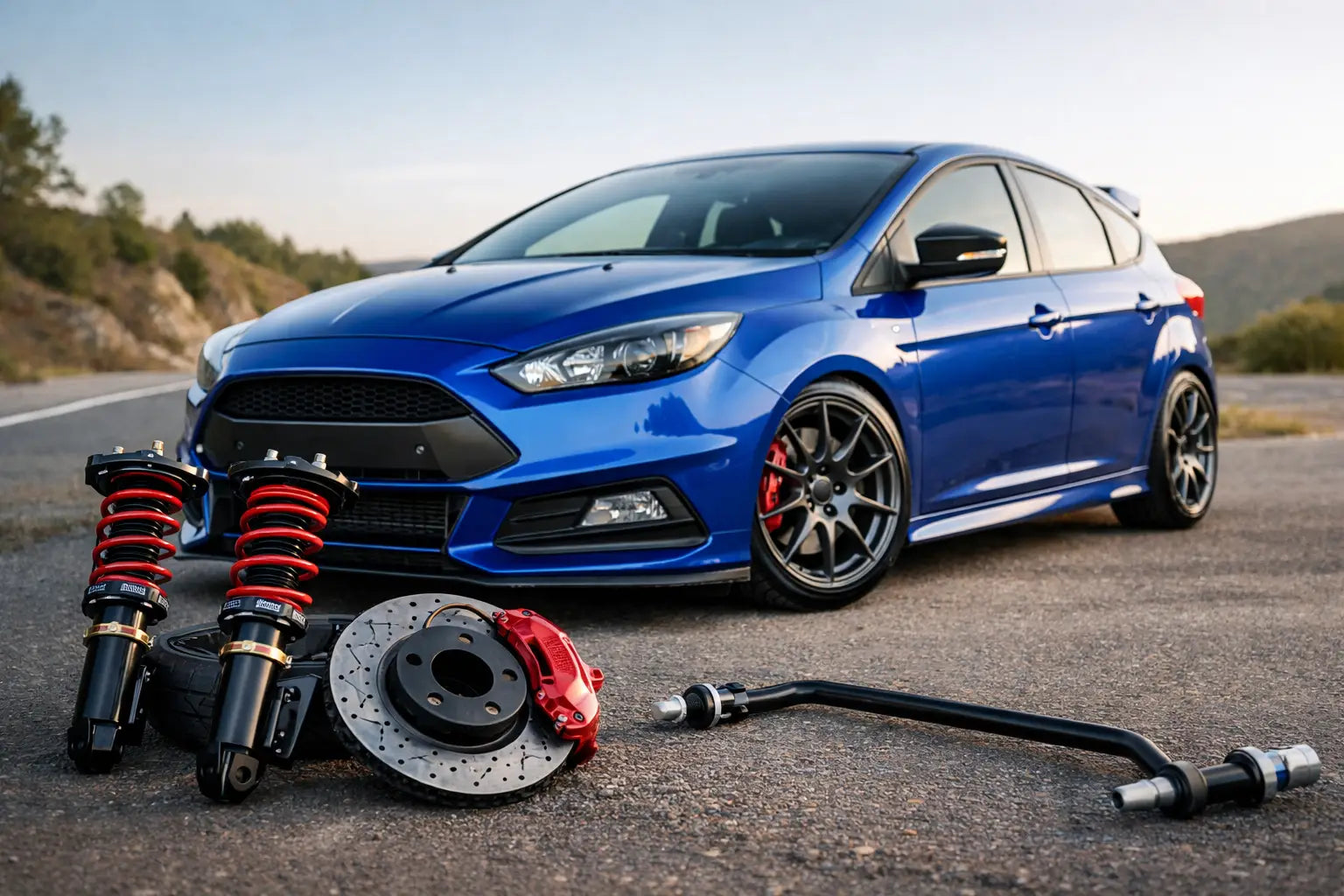
A standard Focus ST is quick enough to feel exciting, but the first hard corner usually tells the truth. There is pace in the chassis, yet there is also roll, front-end push and that slightly soft factory compromise that makes sense for broad road use but leaves plenty on the table. If you are searching for the best Focus ST handling upgrades, the real goal is not just more parts - it is a car that turns in harder, holds a line better and gives you confidence to lean on it.
What actually makes a Focus ST handle better?
Handling is not one magic component. It is the relationship between tyre grip, spring and damper control, body movement, alignment, bush stiffness and chassis balance. Change one area too aggressively and you can make the car worse on real roads, even if it feels sharper for ten minutes.
That is why the best builds start with a clear use case. A fast road Focus ST wants precision without becoming skittish on rough B-roads. A track-day car can tolerate more noise, more stiffness and a narrower setup window if the payoff is better response and consistency under load.
Start with tyres before anything else
People love to jump straight to coilovers, but tyres are usually the biggest handling gain per pound spent. If the contact patch is weak, the rest of the chassis is working around a limitation you created.
A quality performance tyre transforms steering feel, front-end bite and braking stability. On a Focus ST, that means less wash-wide under throttle and more confidence when loading the front axle into a bend. Sidewall strength matters as much as outright grip, because a soft-feeling tyre can dull response even if the compound itself is strong.
Wheel choice also plays a part. Going too large or too heavy can hurt ride quality and suspension response. A lighter wheel with the right width supports the tyre properly and reduces unsprung mass, which helps the damper do its job. If you want a handling-first setup, avoid chasing looks at the expense of weight and tyre performance.
Springs and coilovers - the biggest change in feel
For many owners, this is where the car starts to feel properly sorted. Lowering springs can reduce ride height, tighten body control and sharpen the car up without the cost of a full suspension overhaul. On a road-driven ST, a well-matched spring set can be a sensible step if the standard dampers are still healthy.
The trade-off is that springs alone are always a compromise. They rely on the factory dampers coping with a different spring rate and a shorter operating window. Sometimes that works well enough. Sometimes it gives you a car that looks better but crashes over imperfections and feels unsettled when the road gets rough.
Coilovers offer a more complete answer because spring rates, damping and ride height are designed as a package. The best setups give the Focus ST a tighter platform, cleaner weight transfer and stronger support through faster direction changes. They also let you tune the car around your use. A road-biased kit with sensible damping will feel fast and controlled without becoming tiring. A more track-focused kit can deliver serious precision, but it will expose every poor surface and every bad setup decision.
Choosing coilovers for road or track
If your car spends most of its time on the road, avoid the trap of buying the stiffest kit you can afford. A suspension setup that cannot absorb a mid-corner bump will lose grip, even if it feels aggressive at low speed. For mixed use, compliant damping is often faster than headline spring rates.
If you are building for track work, damping adjustability and heat control become more important. You want something that can take repeated hard use without fading into inconsistency. Ride height should also be set with care. Very low does not automatically mean very capable.
Anti-roll bars change balance fast
If you want one of the most effective Focus ST chassis upgrades for changing cornering attitude, anti-roll bars deserve attention. A stiffer rear anti-roll bar is especially popular because it helps the car rotate more willingly and reduces the built-in understeer that front-wheel-drive hot hatches often carry from the factory.
On the road, this can make the rear feel more alive and the nose easier to place. On track, it can help the car turn in with less steering input and maintain a more neutral balance through medium-speed corners. Get it right and the whole car feels more alert.
Get it wrong and the balance becomes nervous, especially in poor weather or over broken surfaces. This is where honest setup matters. A rear bar upgrade can be brilliant, but it should match the rest of the suspension package and the tyre you run. Too much rear roll stiffness on a damp British road can make the car feel edgy rather than fast.
Bushes and mounts - not glamorous, but serious
This is one of the least flashy areas and one of the most worthwhile. The Focus ST responds well when you reduce unwanted movement in the suspension and drivetrain. Upgraded bushes and mounts bring a more direct feel because the geometry stays more consistent under load.
A rear motor mount is a common first step. It reduces engine movement under acceleration and gearchanges, which improves throttle response and can make the front end feel less vague when powering out of a corner. It is not a pure suspension part, but it absolutely affects how connected the car feels.
Suspension bushes can sharpen steering and improve control during heavy cornering, but material choice matters. Harder compounds increase precision, though they also bring more vibration and noise. For a road car, there is a point where the extra harshness stops being worth it. For a track-biased ST, the trade-off is usually easier to justify.
Geometry setup is where the gains become real
You can fit premium parts everywhere and still end up with a disappointing car if the alignment is poor. Geometry is what ties the build together. Camber, toe and caster dictate how the tyre meets the road, how eagerly the car turns and how stable it feels at speed.
On a Focus ST, more negative front camber is usually one of the most valuable changes for enthusiastic driving. It helps the outside front tyre stay planted in corners, improving grip and reducing shoulder wear. Combined with the right toe settings, it can produce sharper initial turn-in without making the car twitchy.
Rear geometry matters too. It influences stability, rotation and confidence under braking. There is no single perfect number for every car because wheel size, tyre choice, spring rate and driving style all influence the best setup. That is why a proper alignment after suspension work is not optional - it is part of the upgrade.
Strut braces and chassis bracing - useful, but not first
These parts are often marketed as essential, but on most Focus ST builds they are not the first place to spend money. A brace can improve steering feel and add some extra rigidity, especially if the rest of the chassis is already working harder through better tyres and suspension. You may notice cleaner front-end response and a slightly more tied-down feel.
But the gains are usually smaller than tyres, dampers, anti-roll bars or alignment. If your budget is limited, bracing is a finishing touch rather than the foundation. The same logic applies to many cosmetic handling parts that look motorsport-ready but do very little if the actual setup underneath is still standard.
The best upgrade path for most owners
If the aim is a fast, confidence-inspiring road car, start with tyres, then move to a matched suspension setup, then geometry. After that, consider a rear anti-roll bar and selective bushes or mounts to sharpen the final layer of feel. That route gives the biggest improvement without turning the car into a chore.
If you are building a more focused machine, add coilovers with proper damping control, more aggressive alignment and stiffer supporting hardware. At that point, the car starts to feel less like a tuned hatch and more like a properly engineered package. That is where specialist, platform-led parts make the difference, because fitment, durability and real-world testing matter just as much as stiffness figures on a product page.
For owners who want upgrades with real intent rather than generic add-ons, 150 Performance sits right in that sweet spot - parts chosen for drivers who care how the car feels at the apex, not just how it sits in a car park.
Best Focus ST handling upgrades by priority
If you want the short version, the best Focus ST handling upgrades usually fall in this order: tyres, suspension, alignment, anti-roll bars, then bushes and bracing. That sequence works because each step builds on the last. More grip exposes weak damping. Better damping makes geometry changes more effective. Sharper geometry makes anti-roll bar tuning more meaningful.
The mistake is trying to fix a balance problem with one dramatic part. A Focus ST that understeers may not need an extreme rear bar - it may need better front camber and a stronger tyre. A car that feels loose may not need softer springs - it may need alignment correction after being lowered. The fast answer is rarely the simple answer.
A well-sorted ST does not have to feel brutal. The best ones feel calm right up to the point they are very, very quick. That is the target. Build for balance, choose parts with a clear job to do, and let the chassis work the way Ford always hinted it could.
Share:
Ford ST Induction Kit Upgrade Guide
How to Improve Fiesta ST Handling Properly