
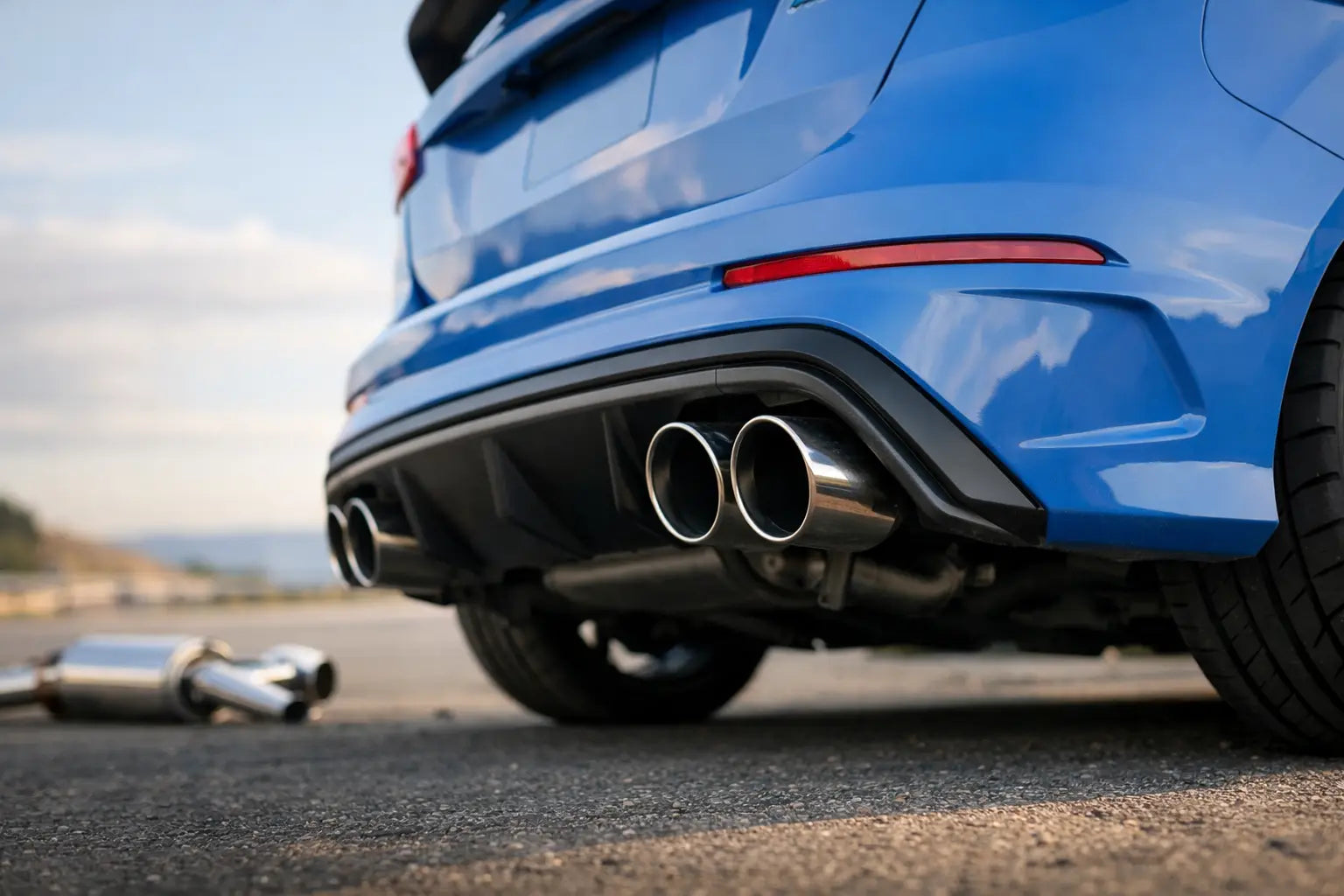
Cold start tells you everything. On a standard Mk3 Focus RS, the car already has attitude, but the factory exhaust still leaves a bit on the table. It crackles, it pops, and it does enough to remind you this is not a warm hatch. Still, if you are reading a Focus RS exhaust review, you are probably chasing something more specific - a harder-edged soundtrack, cleaner flow, less weight, or a system that feels more in keeping with the car’s rally-bred character.
That is where an aftermarket exhaust starts to make sense. Done properly, it changes more than volume. It sharpens the whole experience of the car, from how it sounds pulling out of a roundabout to how it breathes when you are leaning on it through the mid-range. The trick is knowing what actually improves the RS, and what just makes noise.
Focus RS exhaust review - what really changes?
The biggest change is the one you notice first - sound. A good Focus RS exhaust gives the 2.3-litre EcoBoost a stronger voice without turning every drive into hard work. You want more depth at idle, a crisper bark on upshifts, and a more aggressive tone under load. On the right system, the car sounds tighter and more purposeful, not just louder.
After that, flow matters. The stock system is not terrible, especially compared with lesser hot hatches, but it is still built around emissions, refinement and mass production. An aftermarket cat-back or turbo-back setup can reduce back pressure, improve throttle response and, on a tuned car, support stronger power delivery. Gains are usually modest on a standard map with a cat-back alone, but they become more relevant once the car has intake, intercooler and calibration work to match.
Weight is the other factor enthusiasts tend to overlook until they pick up the original system. A well-made stainless or titanium exhaust can trim useful kilos from the rear of the car. That does not transform the RS overnight, but on a platform where owners already care about chassis balance, unsprung reduction and track-day readiness, it is part of a bigger picture.
Sound versus daily usability
This is where most exhaust reviews become worth reading. Plenty of systems sound brilliant for twenty minutes and annoying after a week.
The Focus RS sits in an awkward sweet spot. It is a serious performance hatch, but many owners still use it for commuting, weekend trips and motorway miles. That means drone matters. Cabin boom at cruising speed can ruin an otherwise excellent system, especially if you are doing regular distance work or carrying passengers who did not sign up for full anti-social mode at 70 mph.
Valve-equipped systems usually make the most sense for mixed use. They let you keep things civil when you need to, then open up the car when the road suits it. Fixed systems can still work well, but they need careful tuning in the silencer design and pipe diameter. Bigger is not always better. Some setups sacrifice tone for outright volume, and on the RS that can leave the engine sounding harsher rather than richer.
A strong system should give you contrast between drive modes too. In Normal, it should stay composed. In Sport or Track, it should wake the car up properly. If every mode sounds almost identical, you are losing part of what makes the RS platform fun.
Cat-back, GPF-back and turbo-back - which route suits the RS?
For most owners, a cat-back is the sensible starting point. It changes the character of the car, usually improves flow, and avoids some of the complexity and compliance questions that come with changing components further upstream. Fit one to a standard or lightly modified Focus RS and you get the biggest emotional return for the money.
If your car is later-spec and fitted with a GPF, a GPF-back system may be the appropriate equivalent depending on model year and market. In that case, the result can still be worthwhile, but expectations need to be realistic. Some of the filtration and muting remains in place, so the jump in aggression may not be as dramatic as earlier non-GPF cars.
Turbo-back systems are where performance intent becomes more serious. They can unlock stronger gains when paired with supporting mods and proper mapping, but they also raise cost, installation time and legal considerations. For a road-focused RS, that can be overkill. For a track-driven or power-built car, it is often the right move. It depends entirely on whether you want a better road car or a more committed performance package.
Fitment and build quality matter more than brochure claims
A Focus RS exhaust lives in a hard environment. Heat cycles, road salt, vibration and hard use all expose weak welds, poor hanger positioning and cheap hardware quickly. This is one of those upgrades where materials and manufacturing quality show themselves fast.
T304 stainless remains the sweet spot for most owners. It gives strong corrosion resistance, good durability and sensible value. Titanium is lighter and has the motorsport appeal many buyers want, but the cost jump is significant. Unless weight saving is a genuine priority, stainless usually offers the better balance.
Fitment should be tight, centred and stress-free. Tailpipes that sit unevenly in the rear bumper cut-outs ruin the finish immediately. More importantly, poor routing or hanger geometry can lead to knocks, rattles and long-term fatigue in the system. A proper exhaust should feel engineered for the chassis, not adapted to it.
That is why platform knowledge matters. The best upgrades for the RS are not generic shiny parts. They are designed around the car’s underbody layout, valve operation, thermal load and real-world driving conditions. Built for speed. Engineered for precision. That line only means something if the part actually fits and performs like it should.
How the Focus RS feels with an upgraded exhaust
On the road, the difference is not just acoustic. The car tends to feel keener off the mark, more alert through the rev range and more alive when you are using the gearbox properly. Some of that is measurable, some of it is driver feedback, but both matter. Enthusiast cars are not built on dyno graphs alone.
The RS already has a sense of theatre with its drive modes and overrun character. A better exhaust amplifies that without changing the DNA of the car. It makes short journeys more eventful and hard driving more immersive. When you get a good one, the system feels like it should have been there from the factory.
That said, not every owner wants the same result. Some want a deep, mature tone with only a slight increase in volume. Others want every cold start to sound like a paddock lane. Neither is wrong, but they are very different buying briefs. The mistake is choosing based on clips alone. Microphone quality, surroundings and editing can make almost any exhaust sound better than it really is.
Is it worth the money?
For many RS owners, yes. An exhaust is one of the few upgrades you notice every time you drive the car. It is not hidden behind a panel, and it does not require the perfect road or track session to appreciate. You start the car, hear the difference, and instantly know where your money went.
Value depends on your wider plans. If the car is staying near-standard and you simply want more presence, a quality cat-back is often enough. If you are building around power, then the exhaust becomes part of a proper airflow package and justifies more spend. If you only care about peak bhp figures, there may be other upgrades to prioritise first. But if you want one mod that blends sound, feel and visual improvement, the exhaust is right near the top of the list.
It is also one of the clearest areas where cheap parts can disappoint. Budget systems often chase attention with volume but miss on tone, refinement and longevity. A well-developed system costs more because it solves more problems - sound quality, resonance control, fitment, material quality and flow.
Focus RS exhaust review verdict
A good Focus RS exhaust upgrade absolutely earns its place. It gives the car the voice it should have had from day one, supports future tuning, and adds a stronger motorsport edge without diluting what makes the RS special. The best systems do not just shout louder. They sound cleaner, fit better and feel engineered as part of the package.
If your RS is a daily, be selective about drone and valve control. If it is a weekend or track car, you can afford to be more aggressive with the setup. Either way, buy for build quality and platform-specific design before you buy for headline noise.
For enthusiasts who care about the full driving experience, not just numbers on paper, this is one of the most satisfying upgrades you can make. Choose the right system, and every start-up, every tunnel and every full-throttle pull feels that bit more like the car has finally found its voice.
Share:
How to Improve Fiesta ST Handling Properly
Focus ST induction kit review: worth it?