
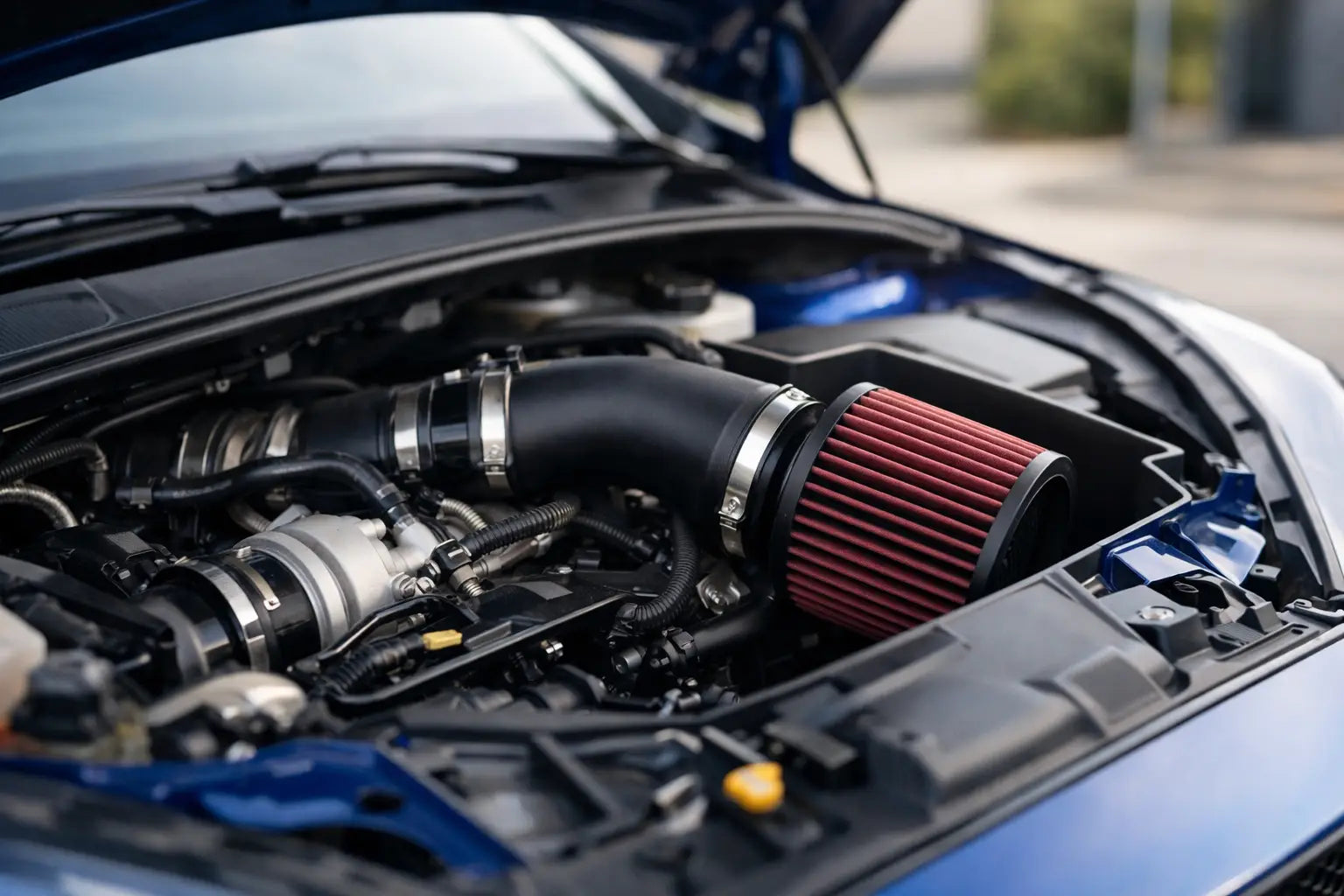
You do not fit an induction kit to a Focus ST because the standard airbox looks too sensible. You fit one because you want sharper response, harder intake noise and an engine bay that looks like it means business. That is exactly where this Focus ST induction kit review starts - not with brochure claims, but with what owners actually care about when the bonnet goes up and the car gets driven properly.
On any turbo Ford platform, the intake side matters more than the usual pub talk suggests. A well-designed induction kit can improve airflow consistency, reduce restriction and make the turbo work in a more efficient window. A bad one can do little more than add noise, pull hot air and leave you wondering where your money went. So the real question is not whether an induction kit changes the car. It is whether it changes it in the right way.
Focus ST induction kit review - what actually changes?
The first change most owners notice is the soundtrack. On the Focus ST, an induction kit brings the turbocharger into the cabin experience in a way the factory setup keeps muted. You hear spool, you hear the bypass valve more clearly, and under load the car feels more alive. For plenty of drivers, that alone makes the upgrade worthwhile.
But noise is the easy win. The more useful difference is how the car responds when you lean on it. A strong kit with a properly sized pipe, smooth bends and an effective heat shield can help the engine breathe more cleanly, especially once you are running supporting modifications or a calibration that asks more from the intake tract. Throttle response often feels crisper, and the engine can pull with a touch more urgency through the mid-range.
That said, it depends on the spec of the car. On a completely standard Focus ST, peak power gains from an induction kit alone are often modest. Anyone promising huge numbers from intake swap only is selling noise with a dyno sheet fantasy. The real value sits in improved flow, better supporting capacity for later upgrades and a more aggressive driving character.
The difference between a proper kit and a loud one
Not all induction kits deserve the same praise. On the Focus ST platform, the strongest options are the ones engineered around airflow management, not just visual impact. Filter size matters. Heat shield design matters. Pipe diameter matters. Even the placement within the bay matters, because turbo cars hate ingesting heat when stationary or crawling through traffic.
A proper kit should separate itself from engine bay temperatures as much as possible and feed the filter with colder outside air. If it uses a thin shield with poor sealing, you may get the theatre without the consistency. That might be acceptable on a weekend toy chasing sound alone, but it is a compromise on a car that sees spirited road use or track work.
Fitment is another area where quality shows itself quickly. A well-developed kit bolts up cleanly, clears surrounding components, and does not need persuasion with cable ties and guesswork. Enthusiasts know the difference straight away. A platform-specific intake should feel like an engineered upgrade, not a universal part with a Ford badge added later.
Sound versus performance - the trade-off is real
This is where an honest Focus ST induction kit review needs to be clear. The loudest kit is not always the best performing one. Open cone systems usually give the biggest jump in induction noise, and for many ST owners that is exactly the point. The car feels more urgent, more mechanical and more motorsport-inspired every time you get into boost.
The trade-off is heat management. An open design can suffer more in slow traffic and hot conditions unless the shield and air feed are properly sorted. A more enclosed setup may be slightly more restrained acoustically, but often offers stronger consistency when temperatures rise. If your Focus ST is a daily driver that sees all-weather use, that balance matters more than a few extra turbo noises outside the local tunnel.
For track-day drivers, consistency wins. Repeated hard laps expose weak intake design very quickly. Heat soak, loose fittings and unstable air temps do not belong on a car built to be driven hard. If your ST is heading beyond basic bolt-ons, choose an induction kit that supports the wider package rather than just the first five minutes after fitting.
What to expect on a standard or lightly modified ST
For a standard or stage 1 Focus ST, an induction kit is best viewed as a character and support modification. You are unlikely to transform the car into something unrecognisable through intake changes alone, but you will make it feel sharper, sound stronger and prepare it for the next steps.
Those next steps usually include a better intercooler, upgraded exhaust components and software that can actually take advantage of reduced restriction. That is where the intake starts to make more sense as part of a complete system. Performance tuning works best when the airflow path is treated as a package, from the filter all the way through to the charge system.
For owners planning only one modification, the intake is still attractive because it changes the driving experience every time you use the car. You hear it, you feel it, and you see it when the bonnet is up. That matters. Enthusiast upgrades are not judged by dyno graphs alone.
Fitment, finish and daily use
A good induction kit should feel premium before the engine even starts. Clean welds, quality silicone, proper brackets and a filter that does not look like an afterthought all count. The Focus ST crowd notices details, and rightly so. If you are spending money under the bonnet, the result should look engineered.
Daily use brings a few practical questions. Will it trigger faults? Usually not, if the kit is designed correctly and the MAF housing dimensions are right where applicable. Will it need more maintenance than the standard intake? Yes, a little. Performance filters need inspection and cleaning at sensible intervals, especially on cars used all year round.
There is also the issue of weather and road grime. In the UK, a car does not need to see a circuit to pick up filth. A low-positioned or poorly shielded filter can become more hassle than hero part if it is constantly exposed. This is another reason why platform-specific engineering matters. Serious parts are designed for real use, not just product photos.
Is a Focus ST induction kit worth the money?
For most enthusiasts, yes - if expectations are correct. If you are buying one for dramatic horsepower gains on an otherwise standard car, you may be underwhelmed. If you are buying it for stronger intake sound, improved throttle feel, cleaner airflow and better support for future tuning, it makes sense.
The best value comes from choosing a kit that matches your build. A daily road car needs strong heat control and OEM-like fitment. A fast-road or stage 2 setup needs enough flow headroom to avoid becoming a restriction later. A track-focused ST needs repeatable performance under heat, not just a loud first pull.
That is why cheap kits so often disappoint. They tend to chase the obvious selling points and ignore the engineering underneath. Serious owners know that the right part is rarely the one shouting the loudest. It is the one that fits properly, performs consistently and still looks the part months later.
At 150 Performance, that is the standard enthusiasts should expect from any upgrade carrying performance claims. Built for speed means more than making noise. It means proper design, proven fitment and results you can feel when the road opens up.
Final verdict from this Focus ST induction kit review
A well-made induction kit is one of the most satisfying entry points into Focus ST modification. It gives the car more voice, more edge and a more purposeful feel without stepping straight into heavy mechanical work. That makes it easy to recommend.
Just be honest about what you want. If your goal is theatre with a little extra sharpness, you will probably love it. If your goal is maximum performance per pound, it works best when paired with the rest of a sorted intake and tuning package.
Choose engineering over hype, fitment over gimmicks and airflow over empty claims. Get that right, and every lift into boost feels like the car is breathing the way it always should have.
Share:
Focus RS Exhaust Review: Worth the Upgrade?
Ford ST tuning guide for fast road gains