

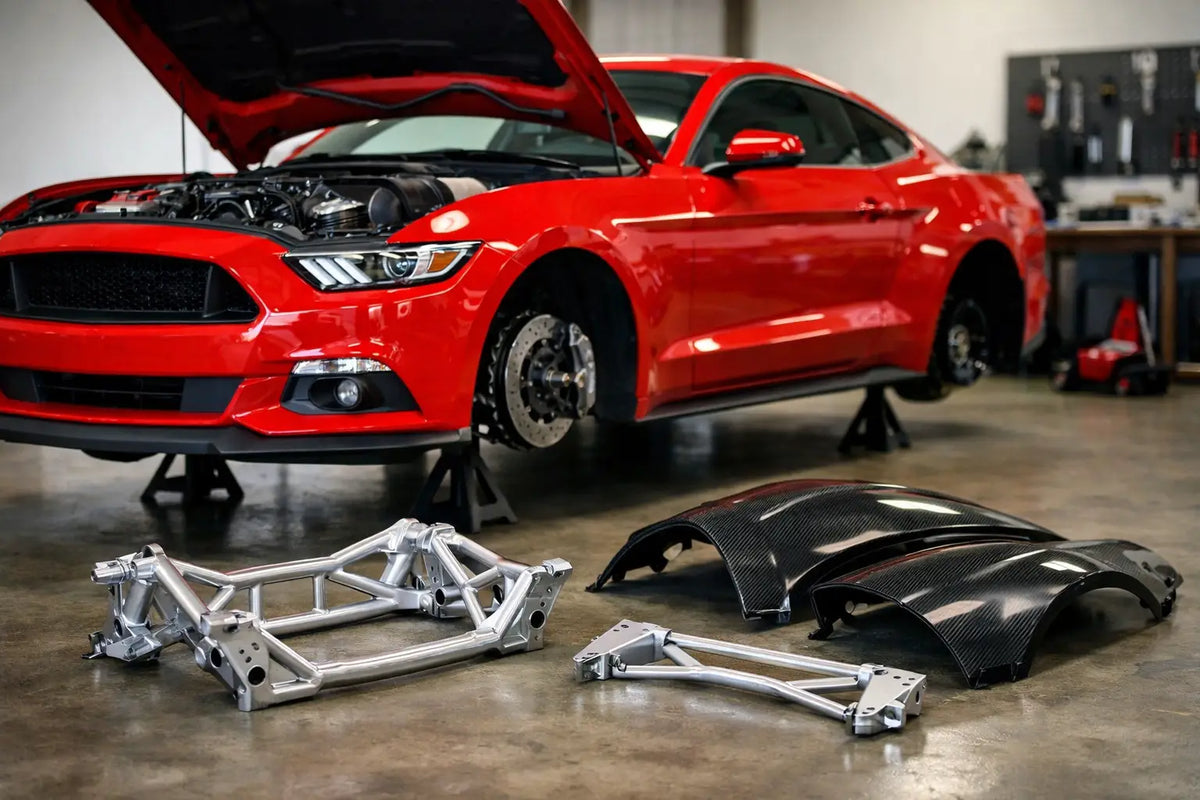
If your Mustang feels strong in a straight line but reluctant to change direction, the issue often starts right over the nose. Anyone serious about chassis balance has asked how to reduce Mustang front end weight, because trimming mass from the front of the car changes far more than the number on a set of corner scales. It affects turn-in, braking stability, tyre load, weight transfer and how willing the car feels on road or circuit.
For performance driving, front end weight is not just a spec sheet talking point. A heavy nose asks more from the front tyres, increases the tendency to push wide on entry, and can make the car feel less precise when you start leaning on it. On a platform with a big V8 up front, every kilo removed from ahead of the axle line matters.
Why reducing Mustang front end weight matters
The obvious gain is lower overall mass, but the better gain is where that mass comes from. Taking weight out of the front end has a bigger effect on balance than removing the same amount from somewhere near the middle of the car. Less weight over the front axle usually means sharper initial response, less understeer and a car that feels more eager to rotate.
That said, there is always a trade-off. Strip too much out without thinking about the package and you can create a car that feels nervous, loses road manners or gives away practicality. The best builds are not just lighter. They are better distributed, better damped and better matched to how the car is used.
Start with the parts furthest forward
If you want the biggest handling return, start with components that sit ahead of the front axle or high up in the nose. That is where weight hurts the most.
Bonnet upgrades
A carbon fibre bonnet is usually one of the most effective visual and functional ways to attack front end mass. The factory bonnet carries noticeable weight, and replacing it with a properly engineered carbon item can remove a useful amount while also lowering the centre of gravity slightly. On track cars, vented designs can add another benefit by helping extract hot air from the engine bay.
Fitment matters here. A bonnet is not a styling trinket. It needs proper structure, clean panel alignment and secure fastening. Cheap panels can create more problems than they solve, especially at speed. If you are building a serious car, this is one area where quality pays for itself.
Front wings and bumper components
Carbon front wings and lighter front bumper elements can also make a meaningful difference, particularly when combined. On their own, each part may not transform the car, but together they chip away at mass in exactly the right area. For owners chasing every advantage, this is how lighter front end builds come together - not always with one dramatic part, but with a series of smart reductions.
The same applies to bumper reinforcement choices, although this is where road legality, crash protection and intended use come into play. A track-focused car can justify decisions a road car should not.
Battery relocation and lightweight battery options
One of the most practical answers to how to reduce Mustang front end weight is the battery. The standard unit is heavy, and it lives in a position that does your front axle no favours. Swapping to a lightweight lithium battery can save a surprising amount of weight straight away.
If you want to go further, relocating the battery to the rear shifts mass where it helps balance rather than hurts it. This is a common motorsport move for a reason. It is not always the right route for a daily-driven car, because installation quality, charging behaviour and cold-weather performance all matter, but from a dynamics point of view it is a strong option.
For mixed road and track use, a high-quality lightweight battery often hits the sweet spot. You get a worthwhile reduction without turning the car into a compromise every winter morning.
Wheels, brakes and the hidden gain of unsprung weight
Not all front end weight is equal. Reducing unsprung and rotational mass at the front can make the car feel quicker, more alert and more controlled, even if the raw weight saving is modest on paper.
Lightweight front wheels are a prime example. A forged wheel package can save weight at each corner while reducing rotational inertia, which helps steering response, acceleration and suspension control. Pair that with a brake setup designed for performance rather than just visual impact and you can sharpen the car considerably.
This is where plenty of builds go wrong. Huge brake kits look the part, but some add weight. If your current setup is already adequate for the power and use case, a lighter rotor and caliper combination may be a better performance decision than simply going bigger. Fast road and track-day cars benefit from parts selection, not guesswork.
Cooling parts, crash bars and front-end hardware
The Mustang front end carries more supporting hardware than many owners realise. Cooling packs, brackets, crash structures and ancillary components all contribute to the total. Depending on the generation and the build goal, there can be opportunities to save weight through lighter brackets, simplified hardware and motorsport-style front-end revisions.
This is an area where platform knowledge matters. Remove the wrong thing and you affect durability, safety or cooling efficiency. Keep the right thing and replace it with something engineered properly, and the result is a cleaner, lighter package that still works under load.
If the car sees heavy track use, cooling should never be sacrificed just to save a few kilos. A lighter nose is no advantage if intake temperatures climb or coolant control suffers halfway through a session.
Exhaust headers and front section choices
People often think of exhaust upgrades as sound and power modifications, but on a Mustang they can also help reduce mass from the front half of the car. Factory manifolds and sections of OEM exhaust hardware can be heavier than a well-designed aftermarket setup.
Long tube headers, lighter connecting sections and carefully chosen materials can take weight out while improving flow. The gain depends on the exact car and setup, and not every system is lighter, so this is another area where the details matter. Stainless systems vary, and if you move into more premium materials the cost rises quickly.
Still, if you are already planning an exhaust upgrade, it makes sense to factor weight into the buying decision rather than focusing only on noise and peak horsepower.
Remove weight high up and ahead of the axle line
When deciding between upgrades, prioritise parts that sit high or far forward. Weight high in the car affects roll, and weight hanging over the nose works against agility. That is why carbon body panels, lighter bonnet assemblies and front-end component swaps tend to feel so effective from behind the wheel.
By contrast, removing a similar amount from somewhere low and central may still help lap times, but it often has less impact on the way the car turns in. If your goal is to make the Mustang feel less nose-heavy, position matters as much as total mass.
Road car or track car - the answer changes
There is no single formula for every owner. A road-driven Mustang needs reliability, weather resistance, proper panel fit and sensible refinement. A track car can accept more noise, fewer creature comforts and more specialised parts.
For a fast road build, the best route is usually a combination of lightweight battery, quality carbon bonnet, forged wheels and carefully chosen front-end components. That gives you a real handling gain without making the car tiring to live with.
For a dedicated circuit build, you can be more aggressive. Battery relocation, stripped front-end hardware, motorsport cooling layouts and more extensive carbon replacement panels all start to make sense. At that point, corner-weighting and alignment become essential because the car is evolving as a system, not just as a collection of parts.
What to avoid when reducing Mustang front end weight
The biggest mistake is buying parts for the look of weight reduction rather than the engineering behind it. A poor-fitting carbon panel, a bargain battery setup with weak cold-start performance, or a brake package chosen on appearance alone will not build a better Mustang.
The second mistake is chasing front-end weight loss while ignoring the rest of the chassis. If the springs, dampers, alignment and tyre setup are wrong, you will leave a lot of performance on the table. Weight reduction works best when the suspension is set up to exploit it.
The third is expecting miracles from one part. Real improvement usually comes from stacking gains - a few kilos from the bonnet, more from the battery, more from the wheels, and more from hardware choices. That is how a heavy front end starts to feel sharper and more disciplined.
The smartest way to reduce Mustang front end weight
If you want a practical route, start with the battery and wheels, then move to carbon bodywork and selected front-end components. Those changes give a strong mix of measurable reduction and real handling benefit. If your build is more serious, tie those upgrades into proper suspension tuning and corner weighting so the chassis can use the advantage.
At 150 Performance, that is the mindset behind every proper upgrade - not just lighter parts, but parts that make the car feel faster, cleaner and more focused when it matters.
A Mustang does not need to lose its character to gain precision. Get the weight out of the nose in the right places, and the whole car starts working harder for you the moment you turn the wheel.
Share:
Focus RS Tuning Guide for Fast Road Builds
Mustang Carbon Fibre Guide for Real Gains