

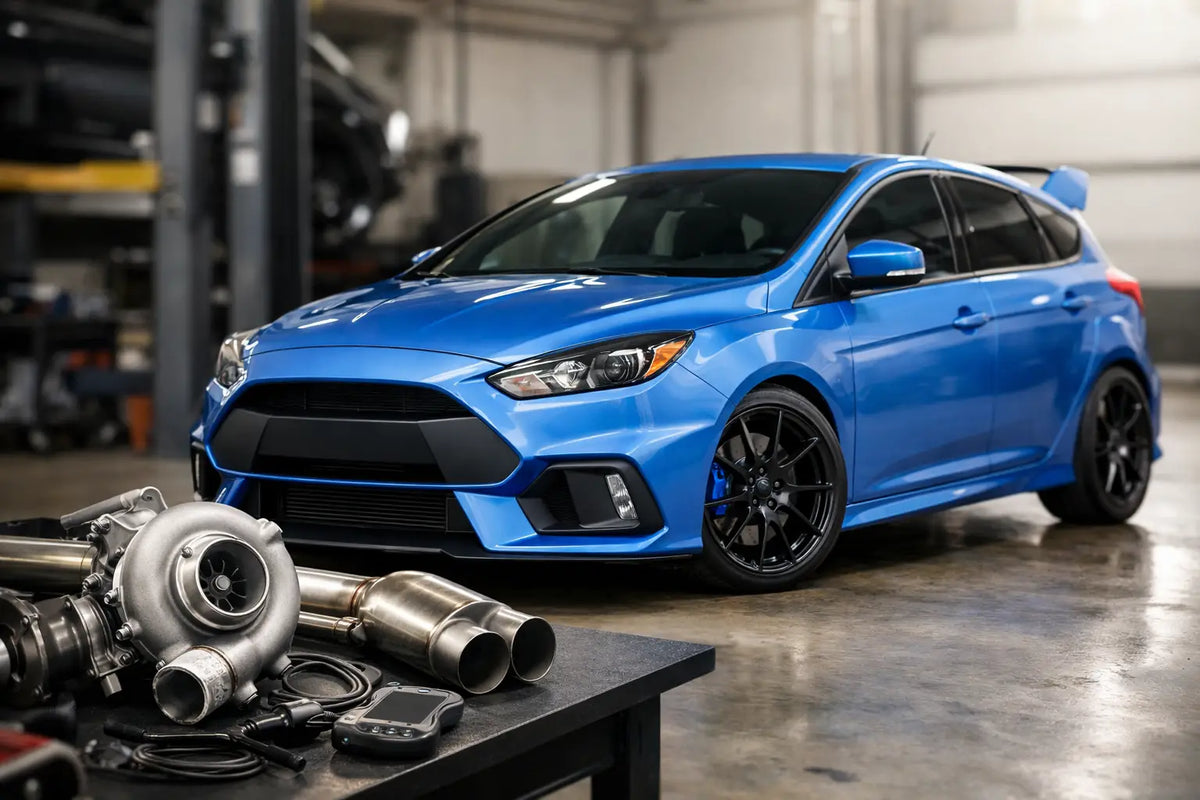
A stock Focus RS is already a serious bit of kit, but anyone who has spent time behind the wheel knows there is more in it. More grip, more response, more boost, more confidence on a hard B-road or a circuit session. That is where a proper Focus RS tuning guide matters - not for chasing pub figures, but for building a car that feels sharper, stronger and better sorted every time you drive it.
The mistake many owners make is treating tuning like a shopping list. Bigger intake, louder exhaust, map, done. The Focus RS does not reward random parts. It rewards a plan. If you want a car that is fast and still enjoyable to live with, every upgrade needs to support the next one.
Focus RS tuning guide - start with your end goal
Before you buy a single part, decide what the car is meant to do. A fast-road build, a track-day car, or something in between will need a different approach. That sounds obvious, but it changes everything from tyre choice to suspension rates to how aggressive your calibration should be.
For a road-focused RS, response and usable power matter more than a dyno headline. You want torque that comes in cleanly, temperatures that stay under control, and chassis balance that works on uneven roads. For track use, the priorities shift. Heat management, braking consistency and oil control become much more important than outright low-down shove.
There is also the budget reality. A well-built Stage 1 or Stage 2 car often feels better than a poorly planned high-power build. If the car spends most of its time on the road, that is usually the sweet spot.
Power upgrades that actually work together
The 2.3-litre EcoBoost responds well to tuning, but it needs a measured approach. The standard car has decent performance out of the box, so the first gains should improve airflow and calibration without pushing the package beyond its limits.
An intake upgrade is a common starting point, but by itself it is not transformative. What it does do is reduce restriction, sharpen induction sound and support later modifications. Pair that with a freer-flowing exhaust and a quality remap, and the car starts to wake up properly. The key phrase there is quality remap. On the Focus RS, calibration is everything. Boost control, fuelling, ignition timing and thermal strategy all need to be right.
A lot of owners jump straight to chasing bigger numbers, but the standard turbo has a useful window where it can deliver strong, responsive performance without becoming laggy or heat-soaked. That makes a sensible Stage 1 setup attractive for fast-road use. It gives the car more urgency without pushing every supporting component to the edge.
Once you move beyond that, supporting hardware stops being optional. An upgraded intercooler is one of the smartest additions you can make, especially if the car sees repeated hard use. Intake air temperatures rise quickly when you are leaning on the car, and once that happens, consistency falls away. A strong intercooler keeps performance repeatable, not just impressive for one pull.
If your target is a proper Stage 2-style setup, think in systems. Intake, intercooler, exhaust and software should be matched. Throwing parts at the car without that joined-up thinking usually leads to disappointment.
The chassis is where the Focus RS earns its reputation
The engine gets the attention, but chassis tuning is what makes an RS feel expensive. The standard platform is capable, yet there is room to make it more precise and more confidence-inspiring, particularly if the car is used hard.
Tyres are the first real tuning upgrade, even if they are not the flashiest. A powerful four-wheel-drive hatch can only use what the tyre gives it. Good rubber improves traction, braking and steering feel in one move. If you are still on mediocre tyres while buying power parts, priorities are in the wrong place.
From there, suspension needs a balanced hand. Lowering springs can improve stance, but they are not automatically an upgrade if the damping no longer suits them. Coilovers offer more control and adjustability, though they only make sense if they are set up properly. An RS that is too stiff might look purposeful, but on British roads it can end up slower and far less enjoyable.
Anti-roll bars, uprated top mounts and alignment changes can make a huge difference too. Geometry is often overlooked because it is less exciting than a shiny hard part, but it changes how the car communicates. A well-aligned Focus RS turns in cleaner, carries itself better through a fast corner and feels more planted when you commit.
Brakes and cooling - the upgrades people leave too late
Ask anyone who has tracked a tuned Focus RS and they will tell you the same thing: power is easy, repeatability is harder. Brakes and cooling are what separate a quick road build from a properly sorted performance car.
A better pad and fluid combination is often enough for spirited road driving, and it is one of the best-value upgrades on the car. You get stronger bite, improved resistance to fade and more confidence when the pace rises. For heavier use, upgraded discs and brake lines start to make more sense.
Cooling deserves the same attention. More boost creates more heat, and heat is the enemy of consistency. Intercooler upgrades help, but engine cooling and oil temperature also matter once you move into regular hard use. It depends on how the car is driven, but if you are doing repeated sessions on circuit, ignoring cooling is asking for reduced performance and extra wear.
Drivetrain and reliability - don’t build weak links
Any Focus RS tuning guide worth reading needs to say this plainly: reliable tuning is proper tuning. There is no point building a car that feels heroic for a month and then starts showing signs of stress.
The RS drivetrain is capable, but once torque climbs, weak points become more obvious. Clutch condition matters, service history matters, and fluid quality matters. If the car has covered decent mileage, it makes sense to bring maintenance up to standard before turning the wick up.
Spark plugs are a small detail that can save a lot of frustration. The same goes for checking boost leaks, making sure the fuelling system is healthy, and keeping the ignition system in top shape. None of it is glamorous, but all of it supports a strong build.
There is also the question of how far you really want to go on the standard engine internals and turbo system. For most owners, the best answer is not that far. A clean, responsive setup with good thermal control is usually the smarter route than pushing for a number that only matters on paper.
Fast road vs track - same car, different tune
This is where many builds go wrong. Owners try to create a car that does everything, then end up with one that is compromised everywhere. The Focus RS can cover road and track use brilliantly, but the parts choice needs honesty.
A fast-road car should feel alive at sensible speeds. That means a broad powerband, compliant suspension, strong mid-range and a brake setup that works from cold. You still want edge and attitude, but not at the cost of daily usability.
A track-focused build can be more aggressive. More camber, firmer suspension, stronger pad compound, more cooling capacity and a setup designed for repeated hard laps all make sense. The trade-off is refinement. More noise, harsher ride quality and increased maintenance are part of the deal.
That is not a bad thing. It just means you should build the car you will actually use, not the one that sounds best in a forum signature.
Where to spend first
If the car is standard and you want a clear route, start with tyres, brakes and a health check. After that, add a proven intake and intercooler package, then tune it properly. Suspension should follow once you know what the car needs from your driving style.
If you are already mapped, step back and assess whether the supporting parts are doing enough. More power on tired tyres, soft factory braking and rising intake temperatures does not make the car faster in the real world. It just makes it feel busy.
This is where specialist, platform-led parts matter. Fitment, heat resistance, material quality and proper engineering all count on a car like this. That is why enthusiasts who want more than a cosmetic upgrade tend to buy from people who understand Ford performance properly, like 150 Performance.
The best Focus RS builds are never random. They are engineered. Every part has a job, every change improves the car’s character, and the final result feels tighter, harder and more capable than stock without losing what made the RS special in the first place.
Build it with a clear target, tune it with mechanical sympathy, and the car will give back far more than a headline bhp figure ever could.
Share:
Valved Exhaust vs Non Valved: Which Wins?
How to Reduce Mustang Front End Weight