
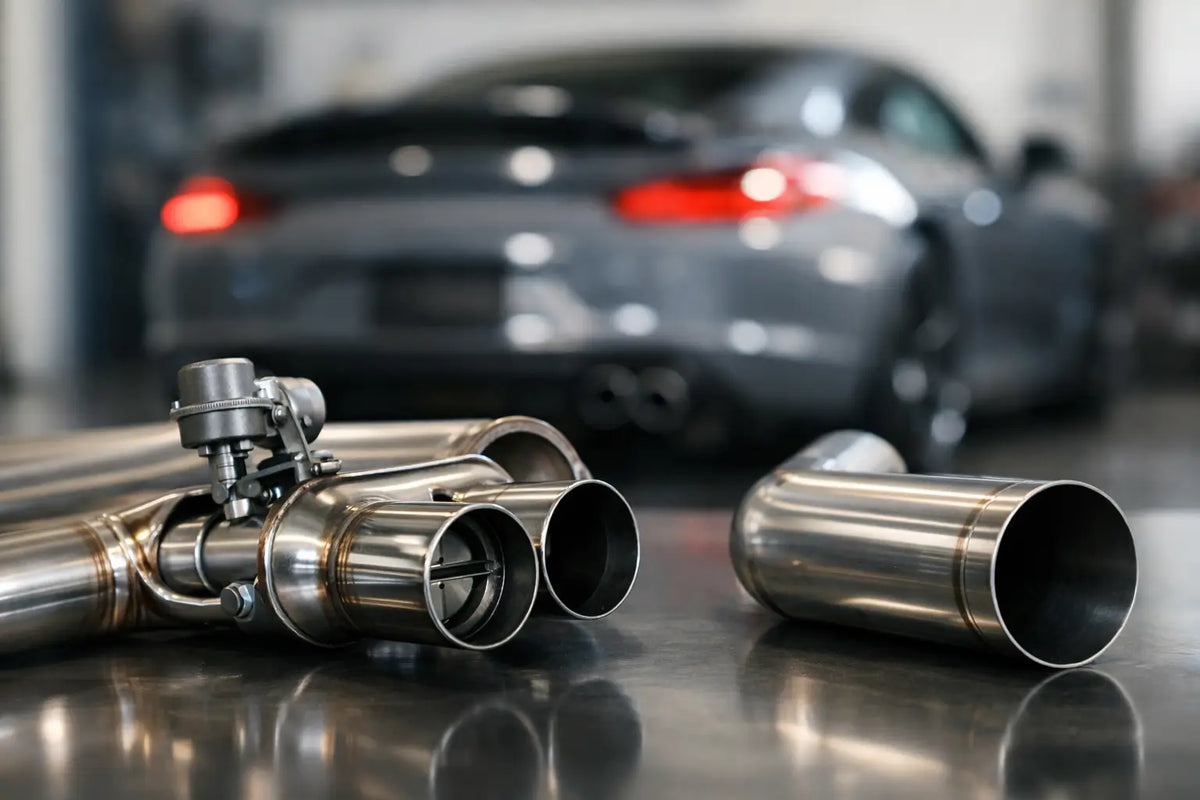
Cold start tells the truth faster than a spec sheet. Turn the key on a tuned ST, RS or Mustang and you know within seconds whether the car has been built for all-out noise or for something more controlled. That is the real heart of valved exhaust vs straight pipe - not just volume, but how you want the car to behave on the road, at the circuit, and when you pull back onto your own drive late at night.
For serious enthusiasts, this choice is about more than attention. Exhaust design shapes the character of the whole car. It changes how aggressive the car feels, how usable it is every day, and whether the setup still makes sense once the novelty wears off. If you are building with intent, the better option depends on your platform, your goals and how much compromise you are prepared to accept.
Valved exhaust vs straight pipe - what is the actual difference?
A straight pipe is exactly what it sounds like. It removes as much restriction as possible from the exhaust path, typically deleting silencers and, in some cases, other components depending on the setup. The goal is simple - maximum flow, minimum filtering, and a raw exhaust note that leaves very little between the engine and the outside world.
A valved exhaust takes a more engineered approach. It uses an internal valve system to change the route of exhaust gases. With the valves closed, gases pass through a quieter section of the system. Open the valves, and flow is redirected through a more direct, less restricted path. That gives you two distinct personalities in one system - civil when you need it, aggressive when you want it.
That distinction matters. Straight pipe setups chase simplicity and intensity. Valved systems chase range. Neither is automatically better in every case.
Sound is where most owners make the decision
Let’s be honest - sound is usually the first reason anyone starts comparing valved exhaust vs straight pipe. On that front, straight pipe delivers the most dramatic result. It is louder, sharper, more immediate and far less filtered. On a turbocharged Ford platform, that can mean harder crackles, more turbo noise and a much more mechanical edge. On a larger-capacity car, it can be completely savage.
The trade-off is that louder does not always mean better. Some straight pipe systems sound incredible at full load and exhausting at part throttle. Cabin drone can turn a quick B-road run into a motorway headache. Cold starts can become antisocial. Depending on the engine and the system design, you can also end up with a note that feels harsh rather than premium.
A good valved exhaust gives you access to that aggressive side without forcing it on you all the time. Valves open, and the car wakes up. Valves closed, and the tone settles down enough for early starts, longer journeys and built-up areas. For many owners, especially those driving performance cars daily, that flexibility is the difference between a car that gets used properly and one that slowly becomes a weekend-only toy.
Does straight pipe make more power?
Sometimes, but not always enough to matter in the way people expect.
Reducing restriction can help exhaust gas flow, and on some builds that supports better performance. If you are working with supporting mods, a proper calibration and a platform that responds well to freer flow, a less restrictive system can absolutely be part of a stronger package. That is why straight pipe appeals to owners chasing every possible gain.
But exhaust performance is not just about deleting parts and hoping for the best. Pipe diameter, back pressure characteristics, turbo behaviour, resonator design and overall system tuning all affect results. A badly thought-out straight pipe setup can sound huge and still feel crude. In some cases, the gains over a high-quality valved system are modest enough that the day-to-day compromises outweigh them.
For road and track builds, the best exhaust is the one engineered around the car, not the one with the fewest components. That is where premium valved systems often justify their price. They are built to manage flow and sound properly, rather than simply stripping everything back.
Daily drivability is where valved systems pull ahead
This is usually the deciding factor for owners who actually use their cars.
A straight pipe setup can be intoxicating for the first few drives. Then reality arrives. Long runs. Passengers. Neighbours. Multi-storey car parks. Police attention. Track day noise meters. Suddenly the constant-volume approach looks less clever than it did on paper.
Valved exhaust systems are built for that reality. They let you keep the theatre without sacrificing usability. Leave the valves shut and the car stays composed enough for normal driving. Open them when the road clears, when you roll into the paddock, or when you want the full character of the build. It is a more mature solution, but not a softer one. It simply gives the driver more control.
For modern fast Fords, performance saloons and premium platforms, that control makes a lot of sense. You can build the car to feel serious without turning every short trip into a full-volume event.
Legality, MOTs and noise limits
This part is less glamorous, but it matters.
Straight pipe setups can push a car into questionable territory very quickly. Depending on what has been removed and how loud the system is, road legality can become an issue. MOT outcomes can be affected. Noise complaints are more likely. If you attend UK track days, sound limits can also become a real problem, especially at stricter venues.
A valved exhaust does not automatically solve every compliance issue, but it gives you a better chance of keeping the car usable in more situations. Being able to reduce volume on demand is a genuine advantage. It can be the difference between being waved through and being sent home.
That matters even more if your car has to cover multiple roles - daily road use, weekend blasts and occasional circuit work. A single-purpose straight pipe setup can be brilliant on the right build, but it is far less forgiving once rules and practicalities enter the picture.
Which suits your platform and build style?
The right answer depends heavily on the car.
On a track-focused or show-focused build that is rarely used for commuting, straight pipe can make sense. If the whole point is maximum drama, minimum restraint and a raw motorsport feel, then the compromises are part of the package. For a weekend-only machine, that can be exactly what the owner wants.
On a Focus ST, Focus RS or Mustang that sees regular road miles, a valved system usually feels like the more complete upgrade. It gives the car edge when you want it and restraint when you need it. That suits how most enthusiasts actually drive. The car still sounds serious, still turns heads, and still delivers the harder-edged character you are chasing - just without boxing you into one setting all the time.
Premium platforms such as Audi, Porsche and McLaren also tend to suit valved systems particularly well. Those cars already balance performance with refinement, so an exhaust that preserves both sides of the car often feels more in keeping with the overall package.
Cost versus value
Straight pipe is usually the cheaper route. Fewer components, simpler design, less complexity. If budget is driving the decision, that is part of the appeal.
But lower cost does not always mean better value. A valved exhaust usually asks for more upfront because the engineering is more involved. You are paying for valve integration, sound management, control hardware and a more sophisticated end result. If the car is something you plan to keep, use often and enjoy in different settings, that extra spend can be money well placed.
There is also resale to consider. A well-made valved system often appeals to a broader range of buyers than a fully straight-piped setup. The more extreme the car becomes, the smaller the audience for it tends to be.
So, valved exhaust vs straight pipe - which should you choose?
Choose straight pipe if your priority is maximum noise, minimum filtration and a raw, uncompromising feel. It suits builds where drama comes first and convenience sits a long way behind. Done properly, it can sound ferocious and feel brutally honest.
Choose valved exhaust if you want performance with options. It is the stronger match for owners who drive their cars properly, not just occasionally. You get the sharper note when the moment calls for it, but you are not stuck with that volume on every journey.
At 150 Performance, that is how we look at any serious upgrade - not as a generic add-on, but as a choice that should match the platform and the way the car is used. Built for speed is one thing. Engineered for precision is what stops a fast road car from becoming a compromised one.
If you are torn between the two, think beyond the first start-up. The best exhaust is not just the one that sounds hardest in a car park. It is the one that still feels right after months of driving, when the build has to perform everywhere that matters.
Share:
Mustang Carbon Fibre Guide for Real Gains
Coilovers Versus Lowering Springs Setup