
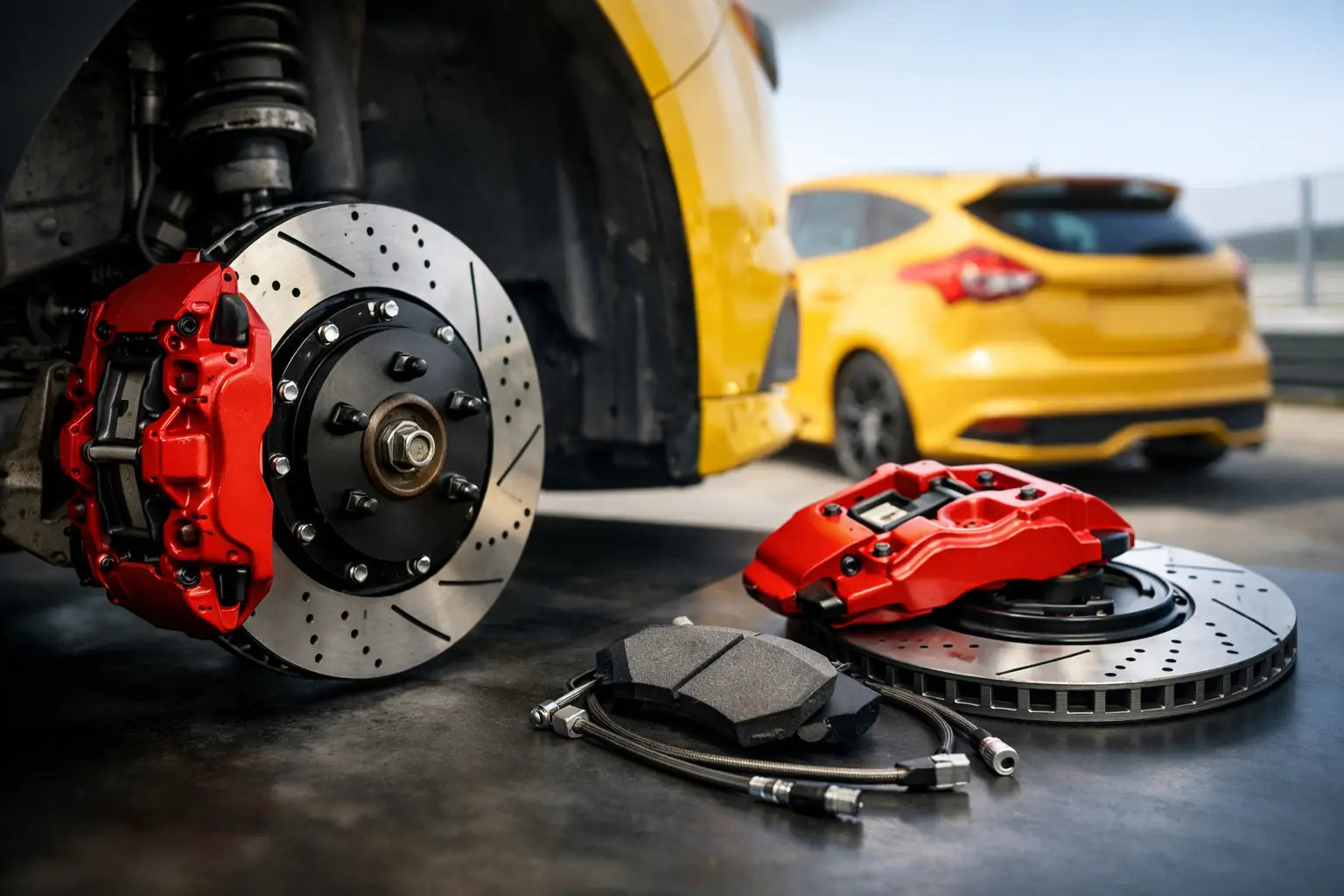
You do not notice weak brakes on the road in the same way you notice them after three hard laps. That is where track day brake upgrades Ford ST owners talk about suddenly become non-negotiable. A Focus ST or Fiesta ST can carry serious speed into a corner, but if the pedal goes long, the fluid cooks, or the pads fade, the whole car feels compromised.
That is the reality of track use. Power is exciting, grip is addictive, but braking consistency is what lets you keep leaning on the car lap after lap. If you are building an ST for proper circuit work rather than one big hero lap, your brake package needs to be chosen like the rest of the car - with heat, balance and repeatability in mind.
Why the standard Ford ST brakes struggle on track
Ford got a lot right with the ST platform. Both Fiesta ST and Focus ST models have strong road manners, sharp front-end response and enough factory braking performance for fast B-road driving. The problem starts when road-spec components are asked to manage repeated high-energy stops.
Heat is the enemy. Standard pads are designed to work quietly from cold, last well in daily use and keep dust under control. On circuit, those same priorities become weaknesses. The friction material overheats, the pedal feel changes, and stopping distances start to grow. Add in old or low-spec brake fluid and you get the classic soft pedal that ruins confidence by the end of a session.
Discs can also become a limit. Once temperatures climb, cheaper or tired discs are more likely to crack, warp or deposit pad material unevenly. What feels like "warped discs" is often poor pad transfer caused by excess heat and the wrong compound.
Track day brake upgrades Ford ST drivers should do first
If you want the biggest gain for the least drama, start with the basics. Not every ST needs a huge big brake kit straight away. In fact, many track-prepared road cars become genuinely capable with a smart first-stage setup.
Performance brake pads change everything
Pads are the single biggest upgrade for most ST owners heading onto circuit. A proper track-focused compound resists fade at higher temperatures and gives a more stable friction window once everything is hot.
That does not mean there is one perfect pad for every driver. A fast-road and occasional-track pad can be ideal if the car still does heavy road mileage. It will usually bite better than stock and tolerate moderate track heat without the noise and dust of a full race compound. If the car sees regular hard sessions, slicker tyres, or power upgrades, a more aggressive pad becomes the better option.
The trade-off is simple. More track-focused pads usually make more dust, more noise and can feel less friendly from cold. That is normal. The point is not comfort - it is repeatable stopping power when the brakes are being punished.
High-temperature brake fluid is essential
A lot of owners spend heavily on hardware and ignore fluid. That is a mistake. Standard fluid boils too easily once brake temperatures rise, and boiled fluid means compressible vapour in the system. That is why the pedal suddenly feels vague or drops away.
A quality high-temperature fluid is one of the smartest upgrades you can make before any track day. It is not glamorous, but it is critical. Fresh fluid with a strong dry boiling point gives you the consistency that actually lets the rest of the system work.
If you are serious about circuit use, change it regularly. Brake fluid is a service item, not a fit-and-forget mod.
Braided brake lines sharpen pedal feel
Braided lines are not magic, but they are worthwhile. Under repeated hard braking, they help reduce line expansion compared with ageing rubber hoses, which gives a firmer, more defined pedal.
You should think of them as a supporting upgrade rather than the main event. On their own, they will not solve pad fade or fluid boil. Paired with track pads and proper fluid, they help make the whole setup feel tighter and more precise.
Do you need upgraded discs on a Ford ST?
Often, yes - but it depends how hard the car is used. If you are doing your first few novice track days on decent pads and fluid, a healthy set of quality replacement discs may be enough. Once pace increases, temperatures rise and session lengths grow, disc choice matters more.
A better quality plain disc is often the smartest route for mixed road and track driving. It offers predictable performance, good heat management and fewer compromises. Grooved discs can help keep the pad face clean and improve bite, but they may wear pads faster and add noise. Drilled discs look the part, but for repeated hard circuit work they are not always the strongest option unless the design and material quality are excellent.
This is where buying by engineering standard matters. Cheap discs sold on looks alone do not belong on a car that is being driven properly.
When a big brake kit makes sense
There is a point where pads, fluid and discs are no longer enough. If your Ford ST is making more power, running sticky tyres, carrying extra speed into every braking zone or simply doing frequent track work, a big brake kit starts to make real sense.
The advantages go beyond bigger discs. You usually get improved thermal capacity, better caliper stiffness, stronger pedal consistency and more even pad pressure across the disc face. That translates into confidence. You brake later, with less drama, and the system stays in its operating window for longer.
But bigger is not automatically better. A front-only big brake kit can alter balance if the rear setup is ignored, and some kits add unnecessary weight if they are not properly engineered. Wheel clearance also matters. You need to consider tyre size, wheel design and intended use before buying anything.
For many ST owners, the sweet spot is a well-matched front kit backed up by the right rear pads, fluid and cooling strategy. Built for speed should still mean engineered for precision.
Brake cooling matters more than most people think
One of the most overlooked track day brake upgrades for Ford ST builds is cooling. Even the best pad and disc setup can be overwhelmed if hot air is trapped and temperatures keep climbing.
Brake cooling ducts or airflow-focused solutions help reduce peak temperatures and keep the system more stable over a full session. That means less fade, less fluid stress and less chance of cracking discs or cooking pad material.
This is especially relevant on heavier or more powerful Focus ST builds, and on cars driven in warmer conditions. If you are consistently overheating brakes, adding more aggressive pads alone may not fix the root cause. Sometimes the answer is simply getting more air where it needs to go.
How to choose the right setup for your ST
The correct brake package depends on the car and the driver. A lightly modified Fiesta ST on road tyres doing two or three track days a year needs something very different from a Focus ST running uprated power and semi-slicks.
Be honest about pace, tyre grip and session length. Faster drivers generate more heat. Better tyres increase braking loads. Extra power means higher speeds at the end of the straight. All of that pushes the brakes harder.
Road use matters too. If the car does the school run during the week and Bedford at the weekend, you may want a compromise pad and a quality disc setup rather than a full race-focused package. If it is a dedicated toy, you can be more aggressive with compound choice and hardware.
The best builds are balanced, not random. Pads, discs, fluid, lines, cooling and tyre grip all need to work together.
Common mistakes ST owners make before a track day
The biggest one is assuming the factory setup will cope because the car feels quick on the road. The second is fitting budget parts in the hope they will survive track abuse. They usually do not.
Another common error is judging brakes by first-bite alone. Strong initial bite can feel impressive, but what matters on circuit is consistency after repeated heavy stops. You are buying heat management as much as outright stopping force.
It is also easy to forget the basics. Worn wheel bearings, poor alignment, old tyres and tired suspension can all make the braking zone messier than it should be. The brake system does not work in isolation.
For owners who want platform-specific parts chosen with actual motorsport use in mind, that specialist approach is exactly why enthusiasts buy from names like 150 Performance rather than generic catalogues.
The upgrade path that usually works
For most drivers, the strongest route is simple. Start with proper track-capable pads, fresh high-temperature fluid and a full system check. Add braided lines if the originals are tired or you want a firmer pedal. Move to better discs once wear or heat demand justifies it. Step into a big brake kit when your pace, tyre and power package start to exceed what the standard caliper layout can comfortably handle.
That progression saves money, avoids mismatched parts and gives you a car that improves in a measured way rather than becoming awkward on the road.
A fast Ford ST is at its best when you can attack the middle pedal as hard as the throttle. Get the brake setup right, and every lap starts to feel cleaner, calmer and faster.
Share:
Lamborghini Aftermarket Exhaust Systems
Best Suspension Setup for Focus ST