
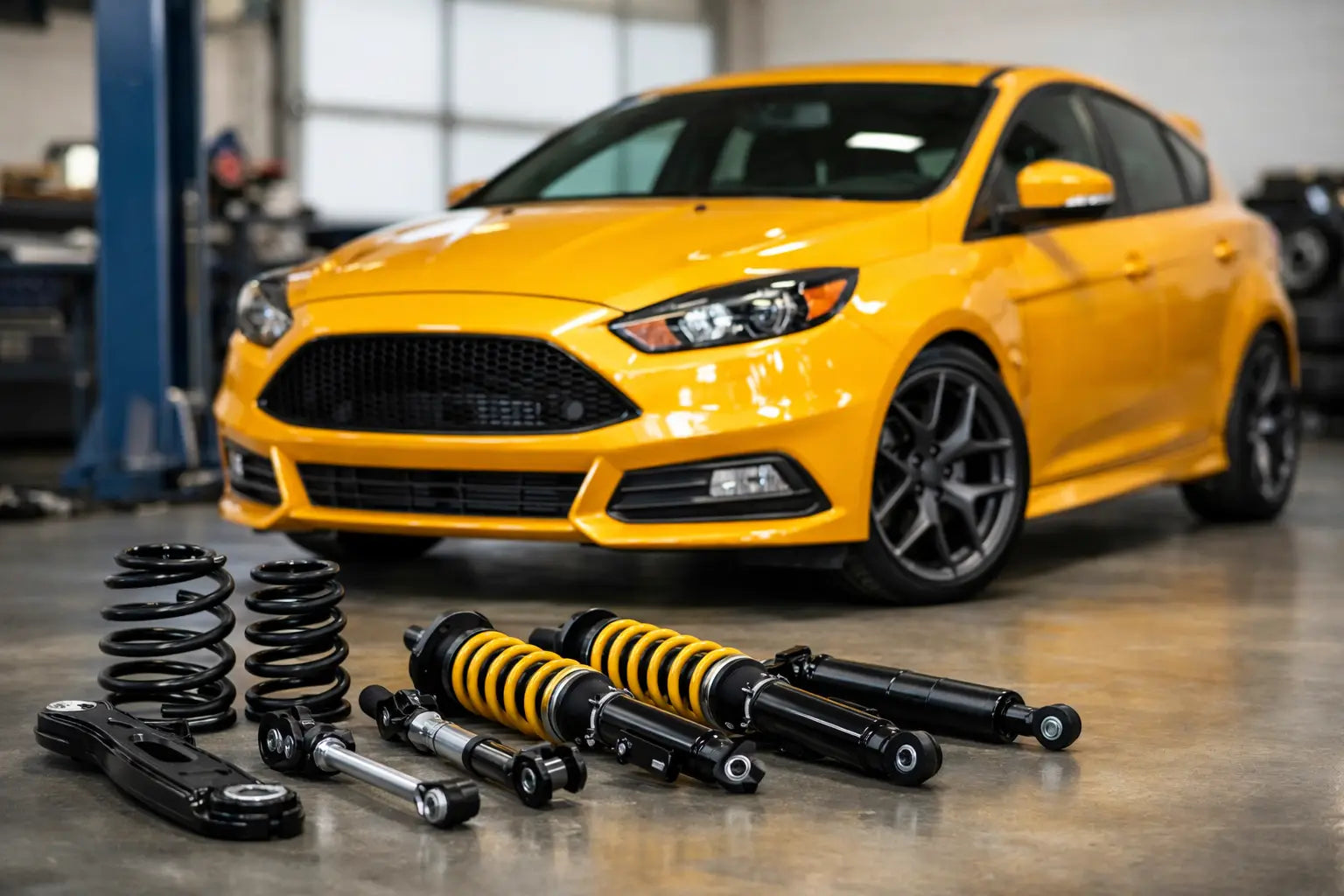
A Focus ST with the wrong suspension feels quick only in a straight line. Turn into a fast B-road corner or load it up through a track-day sweeper and the weak points show up fast - front-end push, crashy rebound, wheel hop under power, and that slightly untidy feeling when the car cannot decide whether it wants grip or comfort. The best suspension setup for Focus ST is not one magic kit. It is the right combination of springs, dampers, geometry, tyre support and intended use.
What the best suspension setup for Focus ST really depends on
If your ST spends most of its life on the road, the best setup is not the lowest or stiffest. It is the one that keeps the tyre working on poor surfaces, controls body movement properly and does not ruin the car every time you hit a patched-up British road. If you do regular track days, the target shifts. You can accept more firmness, more camber and a more aggressive balance because consistency at speed matters more than daily refinement.
That is the part many owners get wrong. They buy suspension by ride height or badge name, then try to tune around the compromises later. A proper setup starts with one question - what do you want the car to do better? Sharper turn-in, less roll, better traction out of slower bends, more confidence under braking, or a cleaner balance across a full lap? The answer changes the spec.
Start with the platform, not the parts catalogue
The Focus ST is a front-wheel-drive performance hatch, which means the front tyres do the hardest job on the car. They steer, they brake, and on corner exit they deal with power as well. Any suspension setup that overloads the front axle will feel dramatic at first and slower the harder you drive it.
That is why a fast ST usually feels disciplined rather than wild. It does not flop onto the outside front tyre, and it does not bounce over mid-corner bumps. The body stays settled, the steering remains accurate, and the rear follows cleanly without becoming nervous. Good suspension makes the car easier to place and faster to trust.
Springs and dampers - where most of the lap time lives
For a road-focused car, matched spring and damper packages are often the smartest move. A quality fixed-rate performance suspension kit can transform the ST without introducing the harshness or inconsistency that cheaper coilovers often bring. You get better body control, less pitch under braking and acceleration, and a much more tied-down chassis on quick road drives.
If you want greater adjustability, a well-engineered coilover kit is the stronger option. This is usually the best suspension setup for Focus ST owners who mix road driving with regular circuit work. The reason is simple. You can fine-tune ride height, damper response and in some cases top mount settings to suit tyre choice, alignment and track conditions.
The catch is that not all coilovers are equal. Cheap kits often chase low stance over damper quality. That means sharp impacts, poor composure on uneven surfaces and reduced mechanical grip when the road gets rough. On a powerful front-wheel-drive hatch, that is the opposite of performance. A properly valved damper matters more than headline stiffness.
For most drivers, a mild to moderate spring rate increase with high-quality damping is the sweet spot. You want less roll and better support, but not so much rate that the car skips across broken tarmac. On track, especially with sticky tyres, you can move firmer. Even then, balance matters more than brute force.
Ride height - lower helps, too low hurts
Lowering the ST improves centre of gravity, reduces roll and usually sharpens the way the car reacts. But there is a limit. Drop it too far and you start to compromise suspension travel, bump absorption and geometry. The car might look aggressive parked up, yet feel worse when pushed.
A sensible drop for a road and fast-road ST usually works better than an extreme one. You keep enough travel in the damper, preserve usable compliance and avoid the exaggerated bump steer and poor roll centre behaviour that can come from over-lowering. Track cars can run lower with the right supporting parts, but the geometry needs to be corrected properly.
That is the difference between suspension built for social media and suspension built for lap times.
Alignment is where the setup comes alive
You can fit premium hardware and still leave performance on the table if the geometry is wrong. Alignment is not an afterthought on the Focus ST. It is one of the biggest factors in how the car turns, grips and wears tyres.
For road-biased use, a touch more negative camber at the front, a stable rear setup and sensible toe settings usually wake the chassis up immediately. You get stronger turn-in, better mid-corner support and less abuse of the outer shoulder on the front tyres. The car feels cleaner and more precise without becoming edgy.
For track use, more front negative camber is often essential. The ST leans heavily on the outside front, and without enough camber the tyre rolls onto its outer edge, overheats and gives up grip. That leads to understeer and greasy laps. A more track-ready alignment helps the tyre stay upright and loaded correctly when cornering hard.
Rear geometry is just as important. Too safe and the car feels lazy. Too aggressive and it can become nervous under braking or direction changes. The goal is a rear end that rotates enough to help the front, but never feels unpredictable.
Anti-roll bars and bushes - useful, but not your first move
There is a tendency to throw anti-roll bars and harder bushes at every handling problem. Sometimes that works. Often it just masks a weak core setup.
If your springs, dampers and alignment are sorted, then anti-roll bars can help fine-tune balance. A rear anti-roll bar in particular can reduce the ST’s natural tendency to push wide, helping the car rotate more willingly on corner entry. It is a popular upgrade for good reason. Used properly, it makes the car feel more alert without needing huge changes elsewhere.
Bushes are more situational. Firmer bushes improve response and reduce deflection, but they also add noise, vibration and harshness. On a track-focused car, that trade-off is usually worth it. On a daily-driven road car, not always. The smart route is to upgrade the areas that genuinely improve precision, not to turn the entire chassis into a vibration amplifier.
Tyres and wheels can make or break the setup
Suspension only works through the tyre. If the tyre is weak, old, mismatched or overheated, no damper on earth will rescue the car.
A strong Focus ST setup needs proper tyres with a sidewall and compound suited to the job. For fast road use, a premium performance road tyre usually gives the best blend of wet-weather safety, steering feel and usable grip. For track days, a more aggressive tyre raises the ceiling dramatically, but it also places greater demand on alignment, damping and temperature management.
Wheel choice matters too. Going too large or too heavy can hurt ride quality and response. Unsprung mass has a direct effect on how effectively the suspension can control the wheel. Lightweight wheels paired with the right tyre size often give a more meaningful improvement than owners expect.
Best suspension setup for Focus ST by use case
If your car is mainly a road machine with occasional hard driving, the winning formula is usually quality matched springs and dampers or a premium road-biased coilover kit, modest ride height reduction, fast-road alignment and excellent tyres. That setup keeps the car usable every day while delivering the sharper front end and tighter body control the ST deserves.
If the car sees regular track action, step up to a higher-spec coilover package with proper damping control, more front camber, carefully chosen rear balance and tyres that can handle repeated heat cycles. At that point, supporting upgrades like top mounts, roll control tuning and selective bush improvements start to make sense.
If you want a car that does both, avoid extremes. Hybrid road-and-track setups are where the best engineering shows. The right parts let the ST stay composed on the road and focused on circuit without feeling compromised in both environments.
The common mistake - chasing stiffness instead of speed
The fastest Focus ST is rarely the stiffest one. Grip comes from the tyre staying in contact with the surface. On British roads especially, a suspension setup that is too hard can make the car slower, less predictable and less enjoyable. You feel every impact, but the stopwatch does not care how dramatic it feels from the driver’s seat.
Real performance comes from control. Control under braking. Control over crests and cambers. Control when power goes down on corner exit. That is where a properly engineered setup earns its keep.
At 150 Performance, that is the mindset behind every serious chassis upgrade - parts chosen for fit, function and genuine dynamic gain, not just stance.
If you are building your Focus ST properly, think like an engineer, not a trend chaser. Decide how the car is used, choose damping quality over marketing hype, and get the alignment right. Do that, and the car stops feeling merely modified and starts feeling built.
Share:
Track Day Brake Upgrades for Ford ST
Do Carbon Fibre Parts Improve Performance?