
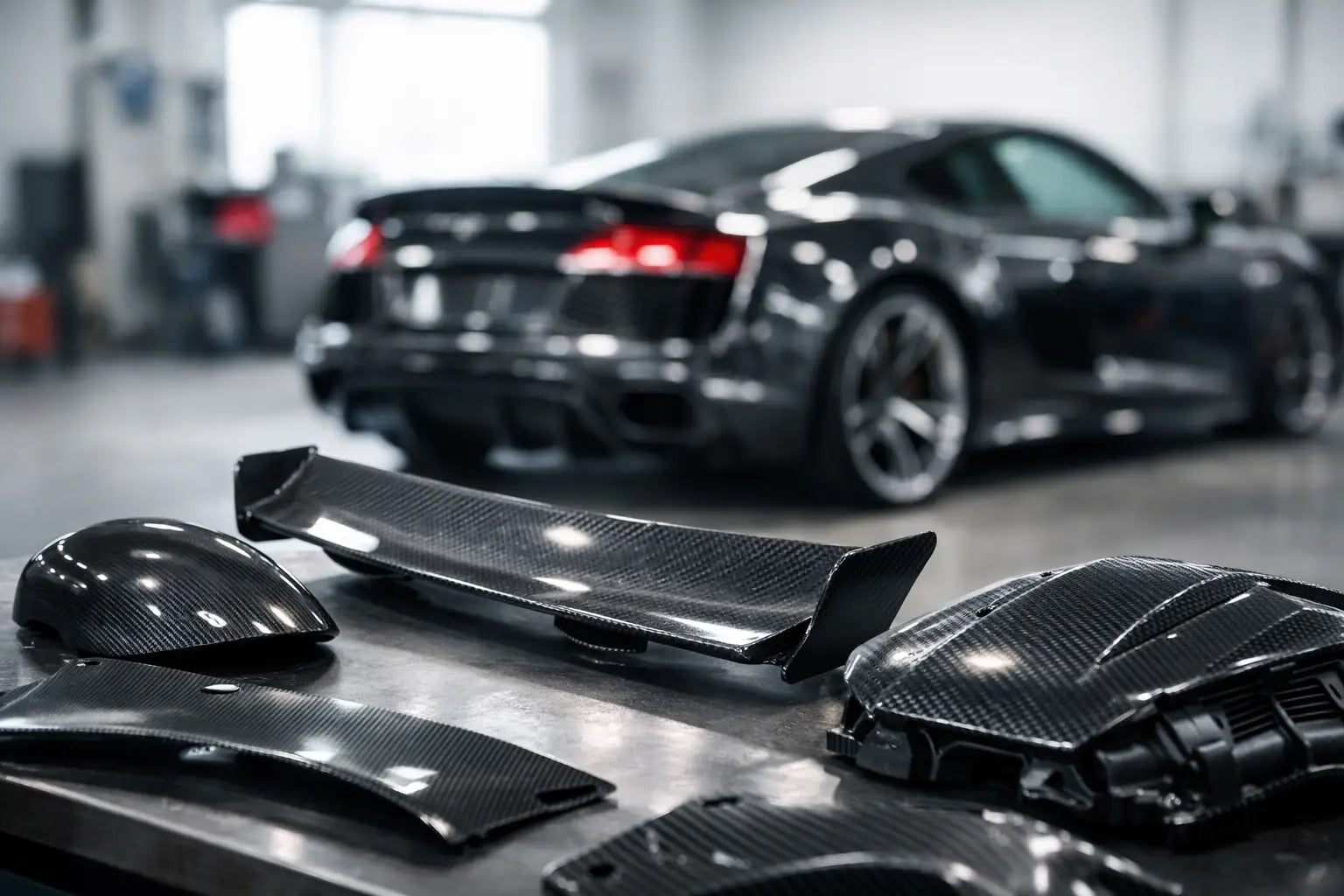
Swap a factory bonnet for a properly engineered carbon fibre panel, and you will feel two things straight away - less weight over the nose, and a car that suddenly feels a bit more serious. That is why enthusiasts keep asking, do carbon fibre parts improve performance? The honest answer is yes, but not every part, not every car, and not in the same way.
Carbon fibre has earned its place in motorsport because it offers a rare combination of low mass, high stiffness and premium finish. On the right platform, and in the right areas of the car, those traits can sharpen response, improve balance and reduce the load your chassis, brakes and tyres have to manage. But there is also a lot of noise in the market. Some carbon parts are genuine performance upgrades. Others are styling pieces wearing motorsport clothing.
Do carbon fibre parts improve performance on road and track?
They can, especially when the part replaces something heavy, poorly positioned or aerodynamically limited. Performance is not just about bhp. It is about how quickly the car changes direction, how stable it feels at speed, how efficiently it sheds heat, and how much confidence it gives you when you commit to a corner or braking zone.
A lighter component reduces the total mass the car has to accelerate, slow down and control. That sounds obvious, but the real gains come from where that mass is removed. Weight taken from high up on the car, such as the bonnet, roof or boot lid, can lower the centre of gravity. Weight taken from the front end can help reduce the lazy, nose-heavy feel that many fast road cars develop once power upgrades start stacking up.
On track, those small changes add up. Turn-in can feel cleaner. Mid-corner composure can improve. Braking stability may feel more settled because the chassis is managing a little less load transfer. You are not suddenly turning a road car into a GT racer with one carbon panel, but you are moving the platform in the right direction.
Where carbon fibre makes the biggest difference
The biggest gains usually come from structural or semi-structural panels, aerodynamic parts and components that sit high on the vehicle. A carbon bonnet is one of the clearest examples. Compared with a standard steel bonnet, a quality carbon replacement can save a meaningful amount of weight from the front upper section of the car. On a Focus ST, Fiesta ST or Mustang build, that can help the front end feel keener and less reluctant on initial turn-in.
Roofs are even more valuable from a dynamics point of view, because the weight sits at the highest point of the shell. This is why carbon roofs carry so much appeal in serious performance applications. Lowering mass there benefits body control and transitional response in a way that is often more noticeable than the raw kilogram figure suggests.
Then there are aerodynamic parts. Splitters, canards, diffusers and rear wings made from carbon fibre do not improve performance simply because they are carbon. They improve performance if they are designed properly. Shape matters more than material here. Carbon fibre helps because it allows a stiff, lightweight aero component to hold its form under load. If a splitter flexes at speed, it loses effectiveness. If a carbon splitter stays stable, it can contribute to front-end grip and high-speed confidence.
Interior carbon parts are a mixed bag. Replacing heavy front seats with lightweight composite bucket seats can be a genuine performance move. Swapping dashboard trims or mirror caps for carbon weave pieces is mostly about appearance. There is nothing wrong with that, but it is worth calling it what it is.
Weight reduction is not just about straight-line speed
Many buyers focus on the power-to-weight figure, and fair enough. Less mass means the engine has less work to do. But on a fast road or track car, the better story is how the whole vehicle behaves.
Take braking. A lighter car carries less momentum into the braking zone, which can reduce heat load and make repeated hard stops easier to manage. Tyres also benefit because they are dealing with slightly less mass in cornering and under braking. Over a session, that can mean more consistency and less punishment for the consumables that keep the car working.
There is also the way a lighter shell feels underneath you. Cars with smart weight reduction often feel more alert, more eager, more connected. You are not waiting for the body to catch up with the steering input. That matters on a back road, and it matters even more when you are chasing tidy, repeatable laps.
When the gains are real, and when they are mostly cosmetic
This is where you need to be ruthless. Not all carbon fibre parts improve performance in a meaningful way. Some save almost no weight because they are just overlays or cosmetic covers. Others may look aggressive but offer no aerodynamic function at all.
Mirror caps, gear surround trims, steering wheel inserts and exterior garnish pieces can transform the visual feel of a build, but they are not the parts that will make your car faster or sharper. If your goal is a genuine performance result, prioritise parts that either remove useful amounts of weight, improve airflow, increase stiffness or support cooling.
Fit and engineering matter as well. A poorly made carbon bonnet that needs forcing into place, vibrates at speed or compromises latch alignment is not a performance upgrade. It is a problem. The same goes for aero components designed with no testing or platform-specific development behind them. Motorsport style is easy to copy. Motorsport function is harder to fake.
That is why serious enthusiasts tend to look for parts developed with proper scanning, CAD work and vehicle-specific fitment in mind. If a component has been designed around the platform rather than made to vaguely fit it, the result is usually cleaner, stronger and more effective.
Do carbon fibre parts improve performance enough to justify the cost?
That depends on what you expect from the upgrade. If you are chasing huge lap-time gains from a single part, carbon fibre can seem expensive. If you understand performance as the result of dozens of small, intelligent improvements, it makes much more sense.
A well-judged carbon build is about cumulative gains. Maybe the bonnet sharpens front-end feel. Maybe the splitter adds stability in quick corners. Maybe the rear wing gives the car more confidence through fast sections. Maybe the interior weight reduction makes the whole package feel less bloated. One part might be subtle. Several parts working together can change the character of the car.
There is also the ownership factor. Enthusiasts do not build cars on spreadsheets alone. They build them because they want something that feels focused, looks right and reflects the level of engineering they care about. A proper carbon component delivers visual impact and performance intent in one move. For many owners, that combination is exactly the point.
The trade-offs you should know before buying
Carbon fibre is not magic, and there are trade-offs. Cost is the obvious one. Good carbon parts are expensive because the material, tooling and finish quality all matter. If the price looks too good, there is usually a reason.
Durability depends on the application. Carbon fibre is very stiff, but that does not mean it likes impact. A carbon splitter can perform brilliantly, yet still lose an argument with a steep driveway or aggressive kerb. Road cars used daily need upgrades chosen with real-world use in mind, not just paddock appeal.
There is also the question of balance. Removing weight from one area of the car changes the vehicle, but not always in isolation. The best builds consider suspension setup, alignment and tyre choice alongside weight reduction. If you are serious about getting the most from carbon parts, think of them as one part of a package rather than a shortcut.
What enthusiasts should buy first
If performance is the priority, start with the parts that offer the clearest functional gain. A lightweight bonnet, properly designed splitter, effective rear wing, or weight-saving seat package usually makes more sense than cosmetic trim pieces. On front-heavy hot hatches and turbocharged fast Fords especially, reducing weight over the nose can be a smart move.
For premium platforms, the same rule applies. Carbon on a Porsche, Audi RS model or McLaren can absolutely support performance, but only when the part is doing a real job. The smartest builds choose carbon where it improves airflow, trims meaningful mass or supports the chassis at speed.
At 150 Performance, that is the difference that matters. Carbon fibre should not be treated as dress-up. It should be selected like any serious upgrade - with a clear purpose, proper fitment and the performance result in mind.
If you are building a car to feel sharper, lighter and more focused, carbon fibre can be one of the best materials you put on it. Just buy with your eyes open, choose function before hype, and let every part earn its place.
Share:
Best Suspension Setup for Focus ST
8 Best Mustang Carbon Fibre Mods