
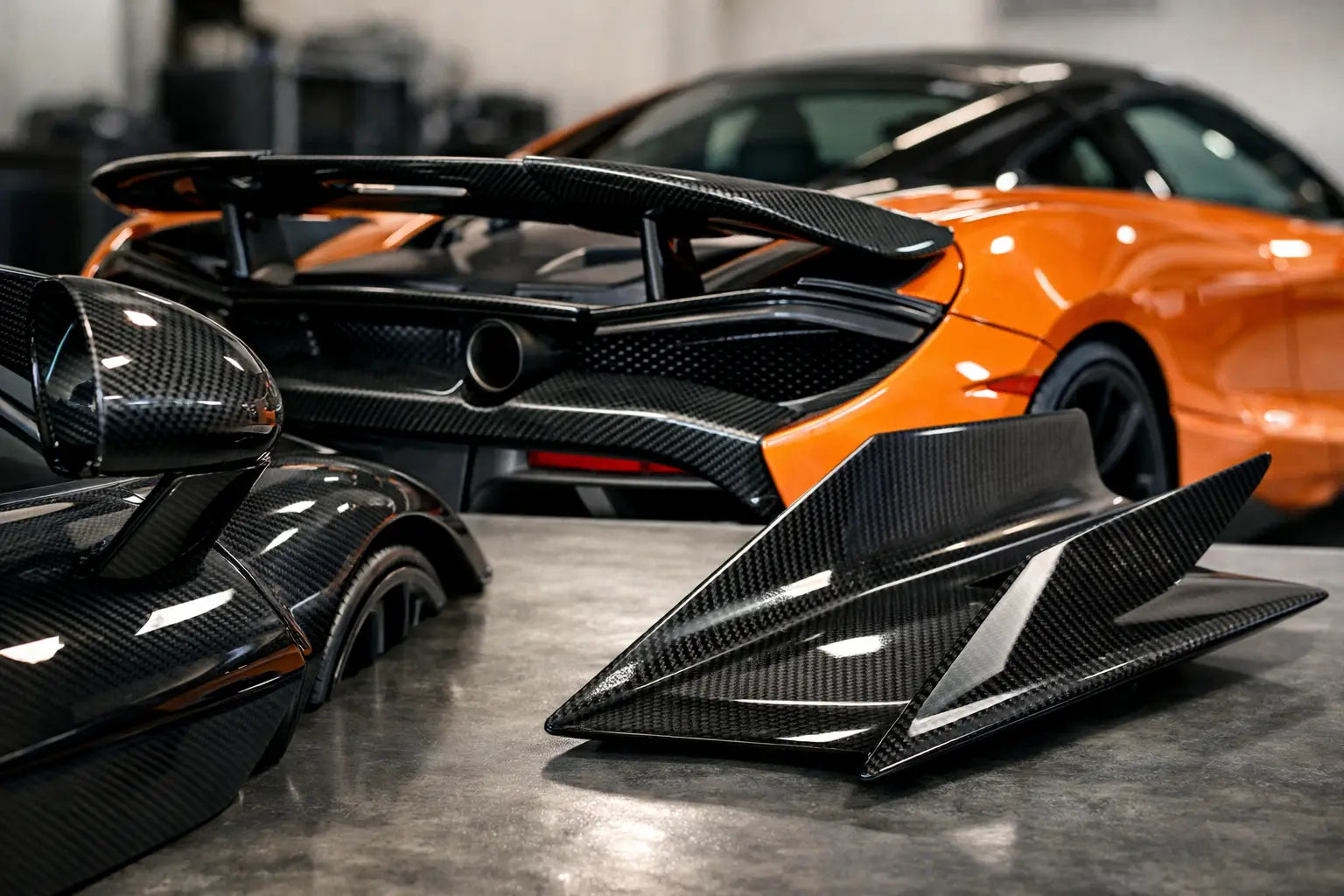
A McLaren does not need help getting attention. What it does need is parts that respect the car it already is. The best McLaren carbon fibre upgrades are not cheap dress-up pieces or badly moulded add-ons trying to imitate motorsport. They are engineered components that fit properly, follow the body lines with intent and bring a real gain in visual aggression, weight saving or aerodynamic control.
That matters more with McLaren than with most platforms. These cars already leave the factory with serious composite engineering, tightly resolved surfaces and a level of design that can be ruined quickly by poor aftermarket choices. If you are modifying a 540C, 570S, 600LT, 720S or Artura, the standard needs to stay high. Carbon fibre only works when the weave, finish, fitment and purpose all line up.
Why McLaren carbon fibre upgrades suit the platform
McLaren ownership attracts a different kind of modifier. You are not trying to rescue a dull factory car. You are refining something already sharp. That changes the approach.
On a McLaren, carbon fibre upgrades make sense because they complement the car's original engineering language. Lightweight construction is already part of the brand's DNA, so exposed carbon does not feel forced in the way it can on lesser platforms. A front splitter, side skirts, mirror caps, rear diffuser or active aero trim in carbon can look completely at home when the shape is right.
There is also the simple fact that these cars respond well to detail. A small visual change carries a lot of impact because the baseline design is so clean. Add the right carbon element and the whole car looks lower, wider and more focused. Add the wrong one and it looks like a parts catalogue exploded over it.
The upgrades worth doing first
The strongest carbon builds are usually the most disciplined. Rather than chasing every panel available, start with the areas that change the car's stance and visual balance.
Front-end carbon that sharpens the car
A front splitter is often the first proper move. It changes the way the nose sits visually, making the car look more planted without fighting the factory lines. On some McLaren models, the front end can benefit from a slightly more defined lower edge, especially if the car is already running a more aggressive wheel and tyre setup.
Front canards and bumper trims can work too, but they depend heavily on the model and the rest of the package. Go too far on the nose without matching the sides and rear, and the car starts to look unfinished.
Side profile upgrades that tie everything together
Side skirts are one of the most effective McLaren carbon fibre upgrades because they lengthen the car and visually lower the sill line. They also link the front and rear aero package into something coherent. If you fit a splitter and leave the sides untouched, the car can feel front-heavy. Side skirts restore the balance.
Mirror caps are more subtle, but on the right car they add a crisp contrast point higher up in the profile. They are less transformative than skirts or a diffuser, though, so they work best as supporting pieces rather than headline upgrades.
Rear carbon with real presence
At the back, the diffuser does most of the heavy lifting. A well-designed carbon diffuser gives the rear end more structure and makes the car look more technical, more motorsport-led and more deliberate. It is one of the few exterior upgrades that can make a McLaren look more serious without pushing into parody.
Rear wings, spoilers and decklid extensions are more divisive. On LT models or cars already aimed at track use, they can look absolutely right. On a road-focused car, especially one with elegant factory aero, a larger rear element only works if it is properly proportioned. Bigger is not automatically better.
Fitment is everything
This is where the gap opens up between premium parts and generic aftermarket stock. Carbon fibre on a McLaren has to fit with factory-level discipline. Panel gaps, mounting points, edge finishing and weave alignment all matter because the car itself is so precise.
If the weave runs off at odd angles from one side to the other, you will see it immediately. If a splitter sits too proud, if a diffuser leaves awkward gaps, or if the lacquer finish lacks depth, the entire car suffers for it. On a cheaper hot hatch, some owners might tolerate that. On a McLaren, it looks wrong from ten feet away.
This is why product development matters. Parts shaped from proper scanning and CAD-led design tend to sit better, flow better and require less compromise during installation. That is not marketing fluff. On a high-value platform with complex surfacing, the development process shows in the finished result.
Gloss, satin and forged carbon - what actually works?
Most owners naturally lean towards gloss twill because it matches the premium supercar look and ties in neatly with factory carbon options. It gives depth, highlights the weave and suits the sharp reflections already present in McLaren bodywork.
Satin carbon can be excellent on darker builds or more track-focused cars, particularly where you want a harder, less jewellery-like finish. It feels more purposeful, but it can also look flatter if the rest of the car is heavily glossed.
Forged carbon is the wildcard. On some applications it looks modern and technical. On others it feels out of character for a McLaren with clean, flowing body lines. It depends on the model and the broader spec. If the goal is timeless rather than trendy, traditional weave is usually the safer choice.
Are McLaren carbon fibre upgrades really about performance?
Sometimes yes. Sometimes not as much as owners like to claim.
A lightweight carbon replacement part can reduce mass, and aero-focused components can influence airflow, front-end stability and high-speed balance. But not every carbon part delivers a measurable dynamic gain. Some pieces are there because they look sensational, and there is nothing wrong with saying that plainly.
The key is honesty about the purpose. A splitter and diffuser package developed with aerodynamic intent has a stronger performance case than decorative vent trims or cosmetic covers. Equally, a few kilos saved high up or at the extremities of the body can be worthwhile, but nobody should pretend mirror caps will transform lap times.
For many owners, the real value sits in the blend of appearance, material quality and platform-correct identity. Carbon fibre makes the car feel closer to McLaren's motorsport roots. That emotional payoff is part of the upgrade too.
Common mistakes buyers make
The biggest mistake is building the car in fragments. Owners buy one aggressive part, then another from a different manufacturer, then a third in a slightly different weave or finish. The result can feel mismatched even if each part looks decent on its own.
The second mistake is chasing the cheapest option. Carbon fibre is one of those categories where poor quality is easy to spot and hard to ignore. Bad lacquer can yellow. Weak mounting can lead to movement. Inferior moulding can create stress at fixing points and an installation that never feels quite right.
The third is overcommitting. McLarens reward restraint. You do not need every vent, trim and blade in exposed carbon to make the car look more focused. Often the strongest builds use fewer parts, but better ones.
Choosing the right upgrade path
If the goal is a cleaner road car, focus on a front splitter, side skirts and a rear diffuser, then decide whether mirror caps or a subtle rear spoiler extension complete the look. That gives the car a sharper stance without overwhelming the original design.
If the car sees serious fast-road or track-day use, you can justify a more assertive aero package, but it still has to work as a complete setup. Front and rear need visual and aerodynamic balance. A giant rear wing paired with a timid front end rarely looks convincing.
For owners who care most about factory-plus presentation, matching weave, finish and fit should outweigh the temptation to fit more parts. This is where specialist suppliers earn their place. A retailer such as 150 Performance understands that premium carbon is not just about showing off the material - it is about supplying upgrades that suit the platform, fit correctly and look engineered rather than improvised.
McLaren ownership already puts you in rare territory. The right carbon fibre upgrades should make the car feel even more exact, more aggressive and more resolved - not louder for the sake of it. Choose parts with purpose, and the result will look fast even when it is standing still.
Share:
Porsche performance exhaust upgrade guide
Lamborghini Aftermarket Exhaust Systems