
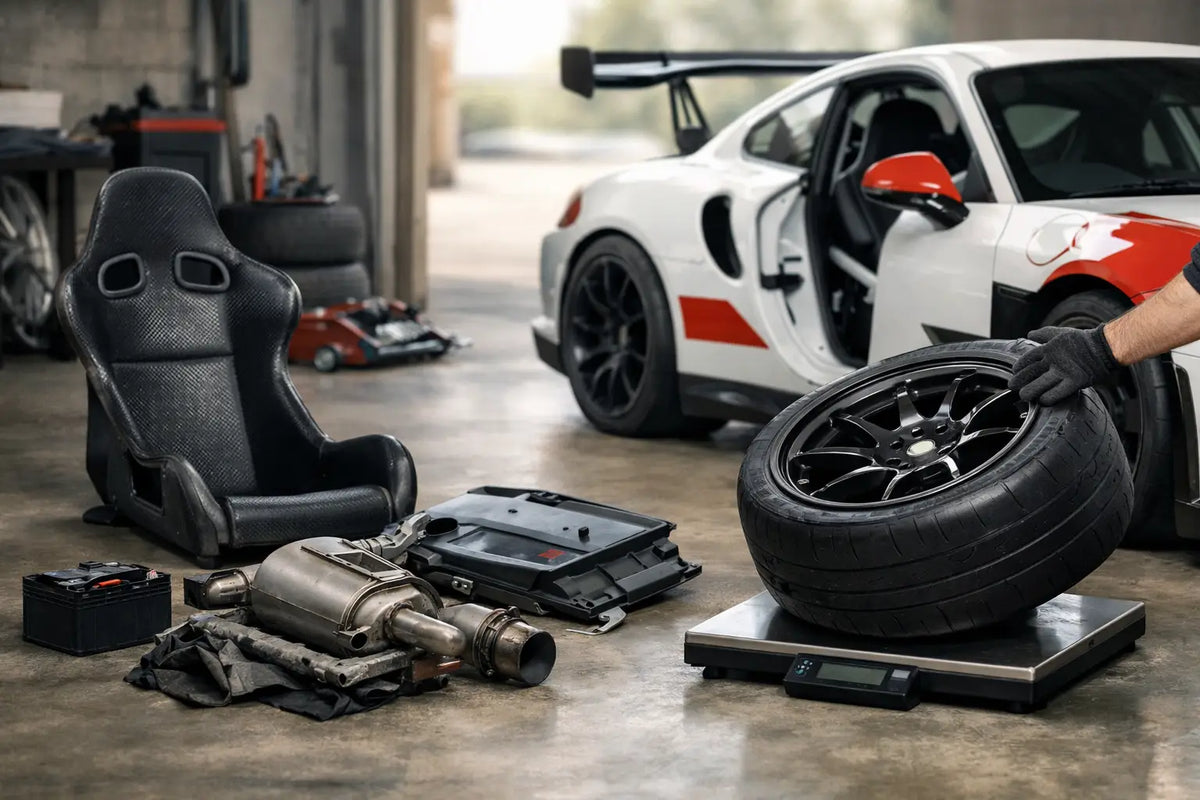
You feel it before the stopwatch confirms it. The car changes direction harder, brakes with less effort, and puts less strain through tyres, suspension and driveline. That is why so many drivers ask how to reduce car weight for track days - not because it sounds clever on a spec sheet, but because lighter cars usually feel sharper everywhere that matters.
The trick is doing it properly. Strip too much out and the car becomes miserable on the road, awkward to live with, or even non-compliant for the series or venue you drive with. Go too cheap and you end up replacing usable factory parts with lightweight bits that fit poorly or add noise without delivering real performance. Smart weight reduction is engineering, not guesswork.
Why reducing weight matters on circuit
Extra power gets the attention, but weight reduction improves almost every phase of a lap. A lighter car accelerates harder because the engine has less mass to move. It brakes shorter because there is less momentum to control. It also changes direction with less inertia, which means quicker turn-in and less punishment through the outside tyres.
There is also the compounding effect. Take meaningful weight out of a track car and you can reduce the workload on brakes, tyres and dampers at the same time. Heat management often improves. Consumables can last longer. On cars that already run hot after a few hard laps, removing mass can be one of the cleanest ways to improve consistency without chasing endless cooling modifications.
That said, not every kilogram is equal. Ten kilos removed from high up in the car will often do more for feel than ten kilos removed low down. Rotational weight matters differently again. If you want the biggest return, focus on where the weight sits and what else that change affects.
How to reduce car weight for track days without ruining the car
The best approach is staged. Start with weight you can remove easily, then move to components that cut mass while improving performance or durability. That keeps the build balanced and stops the car turning into a half-finished compromise.
Start with reversible weight removal
If your car still does daily duties, begin with the obvious non-essential items. Boot trim, luggage floor panels, tools you do not need on track, rear seats where practical, and unnecessary cabin clutter are easy wins. For many hot hatches and saloons, this can save a useful amount without spending anything.
Be realistic, though. Some owners strip interiors, then spend months driving around with drone, rattles and exposed metal because the car became too compromised to enjoy. If the vehicle still sees regular road miles, keep changes reversible at first. A car you can drive to the circuit, enjoy all day, and drive home confidently is usually a better track-day package than an extreme build that only works in perfect conditions.
Seats and mounting hardware make a bigger difference than most expect
Factory seats are often heavy, especially electric or heated units. Swapping to fixed-back bucket seats with proper side mounts can remove a surprising amount of weight while improving driver support. On circuit, that matters. When you are not bracing yourself against the steering wheel in every corner, you drive more precisely and with less fatigue.
This is one of the best examples of dual-purpose upgrading. You are not just saving mass. You are improving your connection with the car. Just make sure the mounting solution is high quality, the seating position is correct, and any harness or belt setup is suitable for the way the car is used.
Lightweight wheels are high-value weight reduction
If you want one of the strongest answers to how to reduce car weight for track days, look at wheels early. Lightweight alloys cut unsprung and rotational mass, which is a serious advantage. The car can react faster over surface changes, steering can feel more immediate, and acceleration and braking both benefit.
Cheap wheels are not the answer. Track use exposes weakness quickly, and poor castings can turn a bargain into an expensive mistake. Prioritise strength, fitment and brake clearance over headline weight figures alone. The right wheel for a Focus ST, GR Yaris or Mustang is not simply the lightest one on paper. It is the one built to cope with heat cycles, kerbs and repeated hard use.
Batteries are easy gains, with some caveats
A lightweight battery can remove a useful chunk of weight from the front of the car, and that can help balance on front-heavy platforms. This is common on turbo hot hatches where every kilo over the nose affects front-end response.
The trade-off is practicality. Some lightweight batteries do not like very cold weather, long periods standing, or lots of electrical demand. If the car is mostly a track toy, that may be fine. If it sits outside all winter and still runs heated screens, upgraded audio and regular road miles, choose carefully.
The best places to save weight
Where you remove mass matters almost as much as how much you remove. High-mounted weight hurts body control. Front-end weight influences turn-in and balance. Rotational weight affects the way the car gains and loses speed.
Carbon fibre panels and aero parts
Bonnets, wings, spoilers, diffusers and selected trim pieces in carbon fibre can reduce weight while giving the car a more focused, motorsport-led finish. On the right build, these parts do more than change the look. A properly engineered carbon bonnet, for example, can take weight from the nose where many performance road cars need help.
This is where quality matters most. Carbon parts should fit correctly, latch securely where relevant, and be designed around the vehicle rather than treated like universal dress-up pieces. Poor fitment, weak mounting points and low-grade finishes are not performance upgrades. They are distractions.
Exhaust systems
A well-designed performance exhaust can trim weight compared with a bulky factory setup, especially where the original system includes large silencers or heavy valve assemblies. On turbocharged cars, this can combine with improved flow and a more purposeful sound.
But be honest about the goal. Some systems save only a modest amount, so the real gain may be in flow, heat resistance and character rather than outright mass reduction. For track-day users in the UK, noise limits also matter. A louder exhaust that gets you black-flagged is not progress.
Brakes and two-piece hardware
Brake upgrades are usually discussed in terms of stopping power, but selected components can also reduce unsprung weight. Two-piece discs with aluminium bells, for instance, can save mass versus some one-piece designs while dealing with heat more effectively.
As always, it depends on the setup. Some big brake kits actually add weight. If your current brakes are already capable, do not assume larger means faster. Focus on heat capacity, pedal consistency and actual mass, not just visual impact behind the spokes.
What not to remove for a track-day build
Weight reduction gets silly when safety and reliability are treated like optional extras. Do not strip airbags, seatbelts or structural parts on a car that still sees road use unless the vehicle is being rebuilt properly for motorsport and you understand the consequences. The same goes for hacking out wiring, deleting cooling components or removing interior sections that protect important systems.
There is also a point where chasing tiny savings stops making sense. Spending heavily to save a couple of kilos from an area that does little for performance is rarely the best use of budget. Most drivers will see bigger gains from driver coaching, proper alignment, tyre choice and brake setup than from obsessive gram-counting.
How to prioritise your budget
The strongest track builds are not always the most extreme. They are the ones built with a clear order of attack. Start with no-cost removal of unnecessary items, then move to wheels, seats and battery if the car suits it. After that, look at carbon fibre components and exhaust changes that genuinely improve the package.
Think in terms of lap-time return per pound spent. A lightweight bonnet on a nose-heavy platform may be worthwhile. Replacing every interior panel with expensive alternatives might not be. The car should feel more precise, not just more stripped.
For Ford platforms in particular, balance is everything. A Focus ST or RS responds well when you reduce front-end mass and improve driver support. A Mustang benefits from careful wheel choice and sensible component selection rather than random parts swapping. Fast road and track cars need a joined-up plan.
How to reduce car weight for track days and keep it usable
The best builds keep one eye on reality. If you still drive the car on the road, leave enough refinement to enjoy it. If you run regular track sessions, choose parts that can withstand repeated heat and vibration. If you want visible upgrades, make sure they are engineered to perform, not only to photograph well.
That is the difference between a car that feels properly developed and one that feels half-finished. At 150 Performance, the strongest lightweight upgrades are the ones that sharpen dynamics, hold up under hard use and suit the platform they are built for.
A lighter car is rarely just lighter. Done well, it feels more alert, more responsive and more committed from the first braking zone to the last lap home.
Share:
Lightweight Carbon Fibre Bonnet Benefits
Best Exhaust for Audi S3: What to Choose