
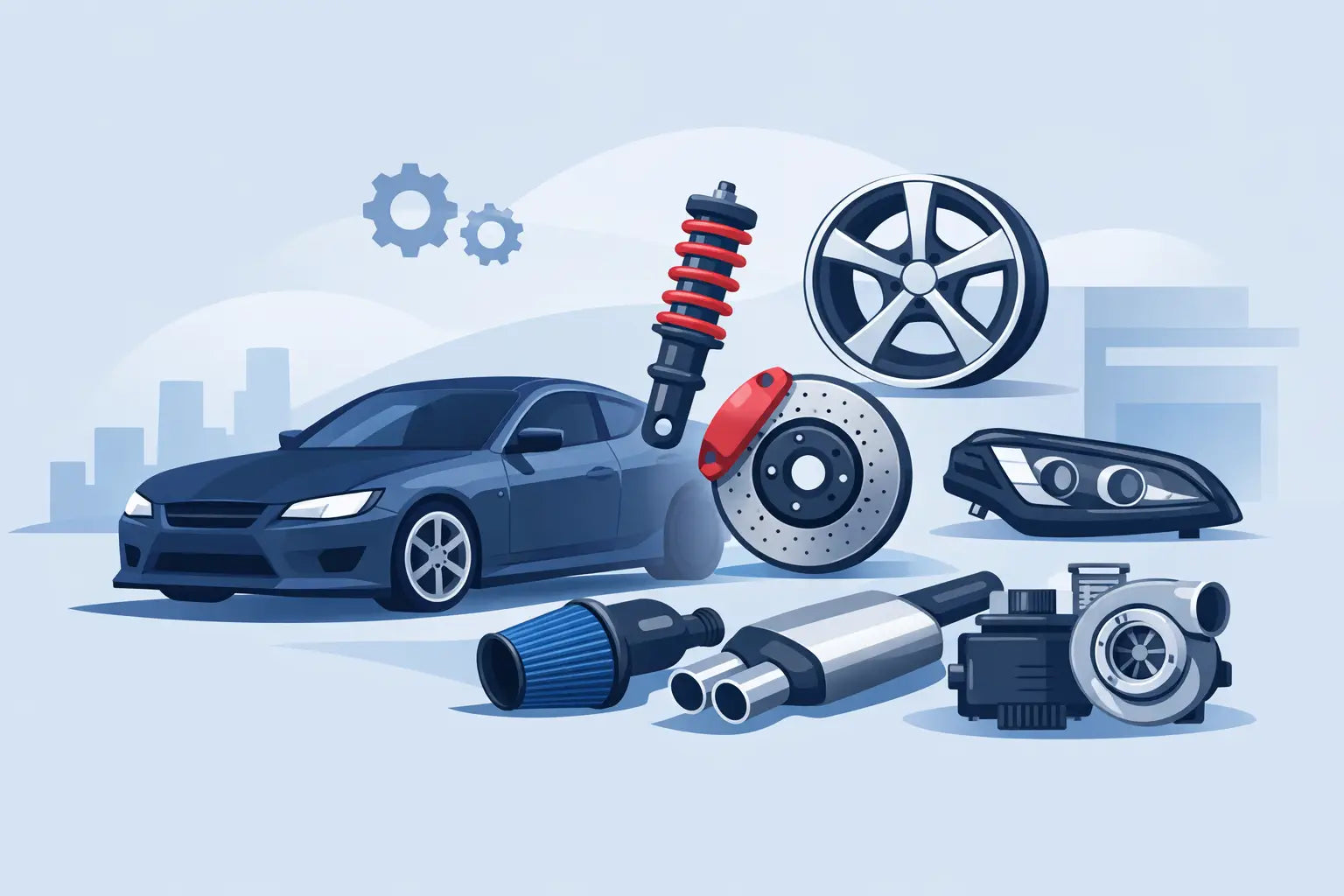
You feel it the first time a standard car starts to feel a bit too standard. Maybe the exhaust note is flat, the handling rolls more than it should, or the factory trim looks safe when you want something sharper, lighter and more purposeful. That is usually when the question comes up - what are aftermarket car parts, and are they actually worth fitting?
In simple terms, aftermarket car parts are components made by companies other than the vehicle’s original manufacturer. So if Ford built the car, but another specialist brand produces the intake, suspension kit, carbon fibre spoiler or brake upgrade, that part sits in the aftermarket. Some are built as direct replacements for worn-out factory items. Others are engineered to improve performance, appearance, sound or durability beyond standard spec.
That difference matters because not all aftermarket parts exist for the same reason. Some are there to save money. Some are there to sharpen a platform that left the factory with compromises. And some are built for drivers who want their Focus ST, Fiesta ST, Mustang or RS to feel more track-ready, more responsive and more personal.
What are aftermarket car parts used for?
The short answer is choice. Car manufacturers build for broad appeal, emissions targets, comfort, cost control and mass production. Enthusiasts usually want something more specific.
That is where the aftermarket comes in. It gives owners the option to improve airflow with a performance intake, free up sound and response with a better exhaust, reduce body roll with upgraded suspension, or cut weight and add aggression with properly engineered carbon fibre parts. On some platforms, the gains are obvious. A factory setup might be competent, but still leave room for tighter handling, stronger braking or more usable power.
For serious owners, the aftermarket is not just about making a car louder or lower. It is about refining the vehicle around a goal. That might be faster lap times, a cleaner road setup, better heat management, more stable aero, or simply a build that feels like it reflects the driver rather than the manufacturer’s committee.
Aftermarket vs OEM - what is the difference?
OEM means Original Equipment Manufacturer. These are the parts fitted by the vehicle maker, or parts made to the same factory specification. If you replace a broken standard intercooler with the same spec intercooler, that is generally an OEM-style repair.
Aftermarket parts are made outside that original supply chain. The quality can vary massively, which is why the term sometimes gets unfairly reduced to meaning cheap copies. That is not what the serious end of the market looks like.
A properly developed aftermarket part can outperform OEM by a clear margin. Think of a cat-back exhaust designed for better flow, a suspension package tuned for sharper turn-in, or a carbon bonnet developed with weight reduction and fitment accuracy in mind. In those cases, the aftermarket is not replacing quality with compromise. It is replacing compromise with intent.
That said, OEM still has its place. If you want factory ride comfort, standard warranty compatibility or a straightforward repair on a daily driver, OEM can be the sensible route. The right answer depends on what the car is for and what you expect from it.
Where aftermarket parts make the biggest difference
Performance cars respond especially well to targeted upgrades because manufacturers often leave headroom in the platform. Turbocharged Fords are a perfect example. The base engineering is strong, but factory components are often tuned to satisfy emissions rules, noise limits, broad-market drivability and production cost.
That is why parts such as intakes, intercoolers, downpipes, suspension arms, brake kits and engine mounts are so popular. They address real limitations. Better cooling supports consistency. Better suspension geometry improves confidence. Better braking reduces fade when the car is driven properly, not just gently to the shops.
Exterior parts sit in the same conversation when they are done properly. A carbon fibre splitter, diffuser or rear spoiler should not just be visual noise. The best pieces are developed around fit, airflow, weight reduction and the overall balance of the car. Enthusiasts can spot the difference straight away between engineered upgrades and generic styling add-ons.
Not all aftermarket parts are equal
This is the point many buyers learn the hard way. Two parts can look similar in a product photo and be worlds apart on the car.
Material quality matters. So does manufacturing tolerance. So does whether the part was actually designed around a specific model rather than made to fit several badly. A cheap intake heat-soaked in traffic, a poorly made exhaust that drones at motorway speed, or a carbon trim piece with weak lacquer and poor weave alignment is not a bargain. It is just the wrong part bought once instead of the right part bought first.
The best aftermarket brands usually show their thinking in the details. Proper testing. Platform-specific design. CAD-led development. Real fitment work. Clear installation guidance. Honest claims. That is what separates engineered upgrades from catalogue filler.
What are aftermarket car parts for performance builds?
For performance builds, aftermarket car parts are the tools that turn a good platform into a more focused one. Some parts chase power, but the smartest builds are usually more balanced than that.
Adding horsepower without improving cooling, traction or braking can make a car feel worse, not better. The same goes for fitting ultra-stiff suspension to a road car that still needs to cope with British B-roads, wet weather and rough surfaces. A fast build is not just a collection of expensive parts. It is a package that works together.
That is why experienced owners often build in stages. First airflow and cooling. Then chassis support. Then braking. Then aesthetics and aero. The exact order depends on the car, but the principle stays the same - match each upgrade to the way the vehicle is actually used.
A track-driven Focus RS needs different priorities from a road-led Mustang. A premium Audi or Porsche build may lean more heavily into carbon fibre and exhaust refinement, while still keeping factory-like fit and finish. There is no single correct formula, only a better-matched one.
The main benefits of aftermarket parts
The biggest benefit is control. You are no longer locked into the factory’s one-size-fits-most approach.
That control can show up as more power, a harder-edged soundtrack, better response, lower weight, improved stance or stronger reliability under demanding use. For many enthusiasts, it is also about identity. A car built with intention feels different because it is different. It has your priorities in it.
There is also a practical side. Some aftermarket parts are stronger than the factory originals, especially on known weak points. Upgraded hoses, mounts, brakes and cooling parts can support reliability when the car is driven hard or tuned beyond stock levels. In that sense, aftermarket does not always mean more extreme. Sometimes it simply means more capable.
The risks to understand before buying
There are trade-offs. That is the honest part of this conversation.
Some aftermarket parts can affect warranty cover. Some can change ride quality, cabin noise or emissions compliance. Some require supporting modifications or professional installation. And some are legal on track but not ideal for road use, depending on the exact setup.
Fitment is another big one. A part can be marketed for your car, but still clash with other modifications, need trimming, or sit poorly if the design work was lazy. That is why buying purely on price is often expensive in the long run.
You also need to be realistic about goals. If the car is your only daily and spends most of its life in traffic, a race-oriented setup may become irritating very quickly. If it sees fast road use and track days, the right aftermarket parts can transform it. Context always matters.
How to choose the right aftermarket upgrade
Start with the weak point, not the trend. If the car suffers from heat soak, fix cooling before chasing headline power. If the brakes fade, sort braking before fitting more boost. If the handling feels vague, address the chassis before adding cosmetic extras.
Next, buy for the platform. A specialist retailer that understands ST, RS, Mustang and premium performance applications will usually steer you towards parts that actually work together. That matters more than flashy product claims.
Then look at the engineering story. Was the part designed around real vehicles? Is the material right for the job? Is fitment taken seriously? Does the manufacturer understand how enthusiasts really use the car? At 150 Performance, that engineering-first approach is exactly what separates serious upgrades from generic aftermarket noise.
Finally, build with a plan. A strong road and track car is rarely created by impulse buying. It is created by choosing parts that support the same outcome - sharper response, better balance, cleaner fitment and performance you can actually feel.
Aftermarket car parts matter because they let you move beyond standard without guessing. The right part does more than fill a space on the car. It changes the way the machine feels beneath you, and that is where a proper build starts to become something worth driving.
Share:
Book Your Track Day Today!
Aftermarket Parts vs OEM: Which Wins?