
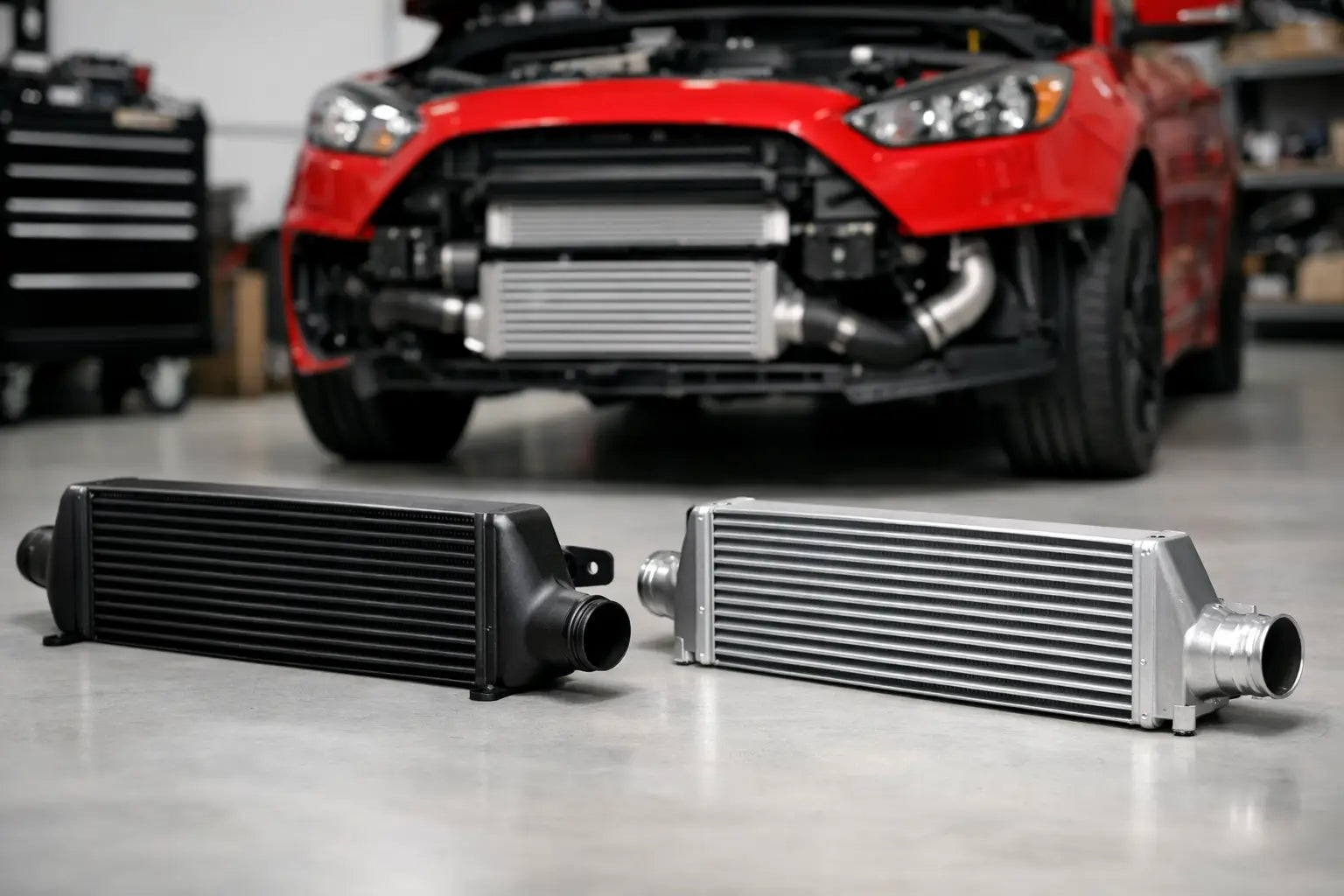
If your Focus ST starts pulling timing after a few hard runs, feeling flat in warm weather, or losing that sharp mid-range punch you paid for, the intercooler is usually one of the first real bottlenecks. That is exactly why so many owners ask how to choose Focus ST intercooler upgrades properly instead of just buying the biggest core they can find.
A good intercooler does one job brilliantly - keep intake temperatures under control so the car delivers repeatable performance. On a tuned ST, that matters even more. You are not just chasing one strong dyno number. You want consistent power on the road, on a B-road blast, or during repeated laps when heat soak starts punishing weaker setups.
How to choose Focus ST intercooler for your build
The right intercooler depends on how you use the car, how far the engine is tuned, and how much compromise you are willing to accept in packaging and budget. There is no single best option for every Focus ST. There is only the best option for your setup.
If the car is mainly a fast road machine with a stage 1 or stage 2 tune, you usually want a well-engineered direct-fit intercooler with a sensible increase in core volume and strong end tank design. If the car sees regular track work, repeated hard pulls, or a more aggressive turbo setup, cooling efficiency and thermal consistency become the priority. That often pushes you towards a larger, more capable core with proven flow characteristics.
This is where a lot of buyers get it wrong. They focus on headline dimensions and ignore the details that actually shape performance. Bigger is not automatically better if the intercooler blocks airflow, adds unnecessary pressure drop, or fits poorly behind the bumper.
Core size matters, but design matters more
A larger core gives the intercooler more surface area and more thermal capacity. That usually helps the car resist heat soak and maintain power for longer. On paper, that sounds simple. In practice, the internal and external design is what separates a proper performance part from an oversized box.
Bar-and-plate cores are popular because they are durable and effective, especially on tuned road and track cars. They cope well with repeated heat cycles and harder use. The trade-off is weight. A heavier intercooler is not always a problem, but if you care about front-end mass and response, it is worth paying attention.
Tube-and-fin designs can be lighter and can work well in some applications, but for a Focus ST running more boost and harder use, most enthusiasts lean towards a quality bar-and-plate setup. The key word is quality. A cheap core with poor internal fin density or badly designed end tanks can hurt response and airflow even if the dimensions look impressive.
End tanks deserve more attention than they get. Cast or properly formed end tanks help distribute airflow more evenly across the core. That means the whole intercooler works harder instead of only using part of the core effectively. Better airflow distribution usually means better cooling and more consistent performance.
Think about your power goal, not just today
If you are planning to stay close to stock power with a mild remap, you do not need the most extreme intercooler on the market. You need an upgrade that cools better than standard, fits cleanly, and supports reliable road use. Spending extra on a massive track-focused setup may bring little real-world benefit.
If you already have a downpipe, intake, uprated boost control and a stronger calibration, your intercooler choice becomes more critical. Higher boost means more heat. More heat means the factory intercooler runs out of headroom quickly. In that case, a proper front-mount upgrade is not just a nice extra. It is part of protecting performance.
And if a bigger turbo is in your plans, buy once and buy properly. It often makes more sense to choose an intercooler with enough capacity for the next stage of the build rather than replacing it twice. That said, there is no point fitting something oversized and awkward now if the future plan is vague and the car spends its life commuting.
Fitment is not boring - it is everything
An intercooler can have excellent specs and still be the wrong choice if fitment is poor. On the Focus ST, clean vehicle-specific fitment matters because bumper clearance, crash bar compatibility, pipe routing and mounting points all affect installation quality and long-term reliability.
A proper kit should sit correctly without forcing the bumper, hacking large sections out of surrounding trim, or creating unnecessary stress on pipework. Bad fitment leads to rattles, boost leaks and frustration. It can also compromise airflow through the radiator pack if the intercooler sits in the wrong position or blocks too much of the front end.
Look for a setup designed specifically for the Focus ST platform, not a universal core made to fit with enough cutting and hope. Enthusiast builds deserve better than that. Precision matters here just as much as outright cooling.
Pressure drop and throttle response
Cooling performance gets most of the attention, but pressure drop is just as important. As air passes through the intercooler, some restriction is normal. Too much restriction means the turbo has to work harder to deliver the same boost target. That can affect efficiency, response and overall drivability.
A well-designed intercooler balances cooling capacity with strong flow. That is why the best units are engineered, not just enlarged. Internal fin design, core thickness and end tank shape all influence how much pressure is lost across the system.
For a road-driven Focus ST, response still matters. You want cooler charge temperatures without making the car feel lazy between throttle inputs. For track use, you may accept a little extra volume if the reward is much better temperature control over long sessions. Again, it depends on the build.
Road car, track car, or somewhere in between?
Be honest about how the car is used. A lot of owners buy parts for the idea of the build rather than the reality of it.
If the car is a daily with spirited weekend driving, choose an intercooler that delivers strong cooling gains without turning installation into a project. You want reliable fitment, better consistency in warmer conditions, and enough headroom for common bolt-on upgrades.
If the car does regular track days, repeated acceleration runs, or sees long periods of hard use, lean harder into thermal performance. Heat soak is where a stronger intercooler really proves its worth. A setup that feels fine on one road pull may struggle badly after ten minutes of proper abuse.
The middle ground is where most Focus ST owners sit. For them, the ideal intercooler is usually a proven direct-fit upgrade from a specialist performance brand with real platform knowledge. That gives you measurable gains without unnecessary compromise.
Build quality tells you a lot
Weld quality, bracket design, finish, and the way the kit arrives all say something about the engineering behind it. Performance parts should look like they were made by people who understand what hard driving does to a car.
Check the details. Are the welds neat and consistent? Are the mounting points properly integrated? Does the manufacturer publish meaningful information about testing, temperature reduction or intended power range? Serious brands do not hide behind vague claims.
This is also where specialist retailers earn their place. A curated performance supplier such as 150 Performance is not just filling shelves. The value is in platform-specific parts chosen for fit, performance and enthusiast expectations, not generic catalogue filler.
Do not ignore the rest of the setup
An intercooler does not work in isolation. Charge pipes, boost leaks, intake temperatures, mapping quality and general engine health all shape the result you feel from the driver’s seat.
If your existing pipework is tired or restrictive, upgrading the intercooler alone may not deliver the full benefit. If the calibration is poor, lower intake temperatures will not magically fix the tune. The best setups work as a package - intake, intercooler, exhaust flow and software all pulling in the same direction.
Budget matters too. It is better to buy a proven intercooler that fits and performs than chase the cheapest option and pay for it twice. On a performance Ford, false economy usually shows up when the car is pushed hard.
What a good choice looks like
If you are still weighing it up, the right Focus ST intercooler usually ticks a few clear boxes. It is sized for your power goal, built with a quality core, designed with efficient end tanks, and made to fit the car properly. It keeps temperatures down without creating excessive pressure drop, and it comes from a brand with a credible performance background.
That means thinking beyond sales language. Ask what problem you are solving. Are you trying to stop power fade in summer? Support a stage 2 setup? Build a car that can survive repeated laps without losing its edge? Once that is clear, the shortlist gets much easier.
The best upgrade is the one that keeps the car fast when conditions stop being easy. Choose the intercooler that matches the way your Focus ST is actually driven, and you will feel the difference every time the car is worked properly.
Share:
8 Best Mustang Carbon Fibre Mods
How to Prepare a Track Day Mustang